




What Are AI Agent Security Providers?
AI agent security providers specialize in securing, monitoring, and governing autonomous AI agents to prevent risks like data leakage, prompt injection, and unauthorized API usage. As these agents become more prevalent, they create new, complex attack surfaces requiring specialized protection.
Agentic AI security is significantly different from traditional application security. AI agents often act with a degree of autonomy, interfacing with sensitive systems or making critical decisions. Providers in this domain bring together identity management, behavior analytics, threat detection, and policy enforcement to ensure that AI agents execute tasks securely and responsibly.
Because many AI agents run inside Kubernetes pods and other containerized workloads, strong container security practices form the underlying foundation on which agent-specific controls depend.
Strong Kubernetes security practices, including network policy enforcement and workload visibility, provide the broader safeguards that agent-specific controls build upon.
This is part of a series of articles about AI agent security.
In this article:
- Key Capabilities of AI Agent Security Providers
- Notable AI Agent Security Providers
- How to Choose AI Agent Security Providers
Key Capabilities of AI Agent Security Providers
Security Posture Management
Security posture management for AI agents assesses and maintains the ongoing resilience of both agents and their operational environments. Providers enable organizations to inventory all agents, monitor configuration drift, and assess vulnerabilities unique to agent logic or runtime dependencies. Automated assessments can identify misconfigurations and outdated libraries that expose agents to exploitation.
Providers also support ongoing improvement with prioritized remediation recommendations, integration with patch management systems, and compliance scorecards. A strong posture management capability ensures organizations can swiftly address discoverable risks, adapt to new threats, and align their agent environments with emerging frameworks or internal policies. This function is central to avoiding the accumulation of risk as AI deployments scale and diversify.
Threat Detection and Real-Time Monitoring
AI agent security providers leverage behavioral analytics, anomaly detection, and threat intelligence to monitor agent activity in real time. These systems analyze vast streams of telemetry from AI agents to spot indicators of compromise, such as unusual network traffic, API usage anomalies, or deviations from normal behavioral baselines. Threat detection engines are often equipped with machine learning capabilities themselves, improving over time to adapt to novel attack patterns targeting agent workflows.
Real-time monitoring is not limited to detection but also powers automated mitigation and response workflows. When malicious or unintended actions are detected, providers can suspend, isolate, or rollback agent activities while alerting security teams for further investigation. This proactive stance is essential to minimize dwell time and reduce overall organizational risk, particularly given the speed and scale at which AI agents can operate without direct human oversight.
Behavior Analytics and Investigation
Behavior analytics in AI agent security revolves around profiling expected agent behavior and continuously contrasting it with observed operations. Providers build detailed usage models, flagging deviations that might indicate compromised code, policy breaches, or attempts at unauthorized data access. By establishing baselines for each agent, these systems help rapidly distinguish benign outliers from genuine threats, even as agents adapt and evolve with changing input or contexts.
Investigation tools within these platforms enable deep forensics, linking anomalous agent behaviors to broader security incidents. Security teams can reconstruct agent activity timelines, correlate events across agents, and identify root causes of suspicious behavior. This focus on detailed analytics and investigation strengthens post-incident analysis and improves future threat prevention, fostering a cycle of continuous improvement in agent security management.
Threat Prevention and Guardrails
Instead of relying solely on detection and response, leading AI agent security providers invest in robust preventive controls and guardrails. These guardrails define clear operational boundaries for AI agents, controlling which commands, APIs, or data sources they can access. This reduces the likelihood of unintended actions, data exfiltration, or exploitation by external threats exploiting agent logic.
Security providers enforce preventive measures through allow/deny lists, sandboxing, input validation, and dynamic policy constraints. They also monitor and throttle agent interventions during elevated-risk operations, ensuring any deviation from prescribed workflows receives scrutiny. The outcome is a hardened agent ecosystem where prevention, not just detection, becomes a foundational tenet of security.
Identity and Access Management
AI agent security providers offer advanced identity and access management (IAM) features tailored to autonomous agent environments. These capabilities go beyond basic user authentication, introducing granular policy controls for machine identities, credentials rotation, and activity monitoring tied specifically to AI agents. Their systems often integrate with directory services and support federated identity models, ensuring that only authorized agents access sensitive data or critical infrastructure, thereby reducing the attack surface created by autonomous processes.
Effective IAM also covers aspects such as least-privilege enforcement and role-based access for both human and non-human actors. Providers employ auditing and real-time anomaly detection to identify when agents exceed their intended scope, attempt privilege escalation, or behave unpredictably. By maintaining strict visibility and control over what agents can access and under which conditions, organizations minimize the risk of insider threats, compromised agents, or lateral movements within their environments.
Centralized Security Governance
Centralized security governance is crucial for organizations operating fleets of AI agents across diverse systems and environments. Providers deliver unified policy management, enabling organizations to define, enforce, and monitor security policies across all agents from a single interface. This approach streamlines compliance checks, audit processes, and incident response by cataloging agent actions and enforcing uniform safeguards organization-wide.
Such governance extends to continuous policy evaluation and the propagation of rule updates as new threats or compliance demands emerge. Providers facilitate detailed reporting, automated remediation, and alerting mechanisms that bridge security operations centers (SOCs) with development and DevOps teams. By consolidating oversight, organizations ensure consistent security postures while adapting swiftly to the evolving risk landscape inherent to AI-driven operations.
Learn more in our detailed guide to AI agent governance
Notable AI Agent Security Providers
1. Tigera Lynx

Tigera provides Lynx, a unified control plane for Kubernetes-native AI agents. Lynx sits in the path of every agent call (agent-to-agent, agent-to-tool, and agent-to-LLM) to authenticate, authorize, mediate, and audit each one. It gives enterprises a single place to find every agent in their Kubernetes estate, tighten posture, assign a sandbox, give each agent cryptographic identity, enforce policy on every action it takes, audit what agents actually do and detect anomalous behavior. Lynx plugs into the tools enterprises already run, including their identity provider (EntraID, Okta) or via SPIFFE/SPIRE, and existing observability systems, and is built on open standards rather than proprietary lock-in.
Key features include:
- Discovery, registration, and observability: A central registry catalogs every agent with its owner, purpose, and version, while eBPF-powered auto-discovery finds agents nobody registered. Shadow agents are flagged and quarantined, and any agent’s actions can be reconstructed end-to-end through OpenTelemetry traces.
- Configuration and posture management: AI-CSPM continuously evaluates every agent against a baseline, surfacing drift and over-permissions the moment they happen, with per-agent sandboxing and pre-built compliance packs mapping to GDPR, HIPAA, SOC 2, and financial services requirements. A Red Team Agent continuously probes for weaknesses in posture and misconfigurations.
- Identity and authentication: Every agent gets a verifiable cryptographic identity through integration into an enterprise’s identity provider (EntraID, Okta) or through SPIFFE/SPIRE, with no shared secrets. Long-lived API keys are replaced by short-lived and tightly scoped, auto-rotated tokens. A JWT token is minted for every hop in a multi-agent workflow.
- Policy definition and enforcement: A single default-deny policy governs LLM, MCP, and agent access using the Cedar policy language, enforced at the gateway before any call executes — with no agent code changes. Misbehaving agents can be quarantined instantly and high-stakes calls routed to a human.
- Anomalous behavior detection: eBPF and LSM watch every syscall, network call, and file access at a layer agents can’t tamper with, catching credential theft and lateral movement even when an action passes policy. This provides a forensic audit trail. Guardian Agent detects anomalous
 behavior and quarantines suspicious agents.
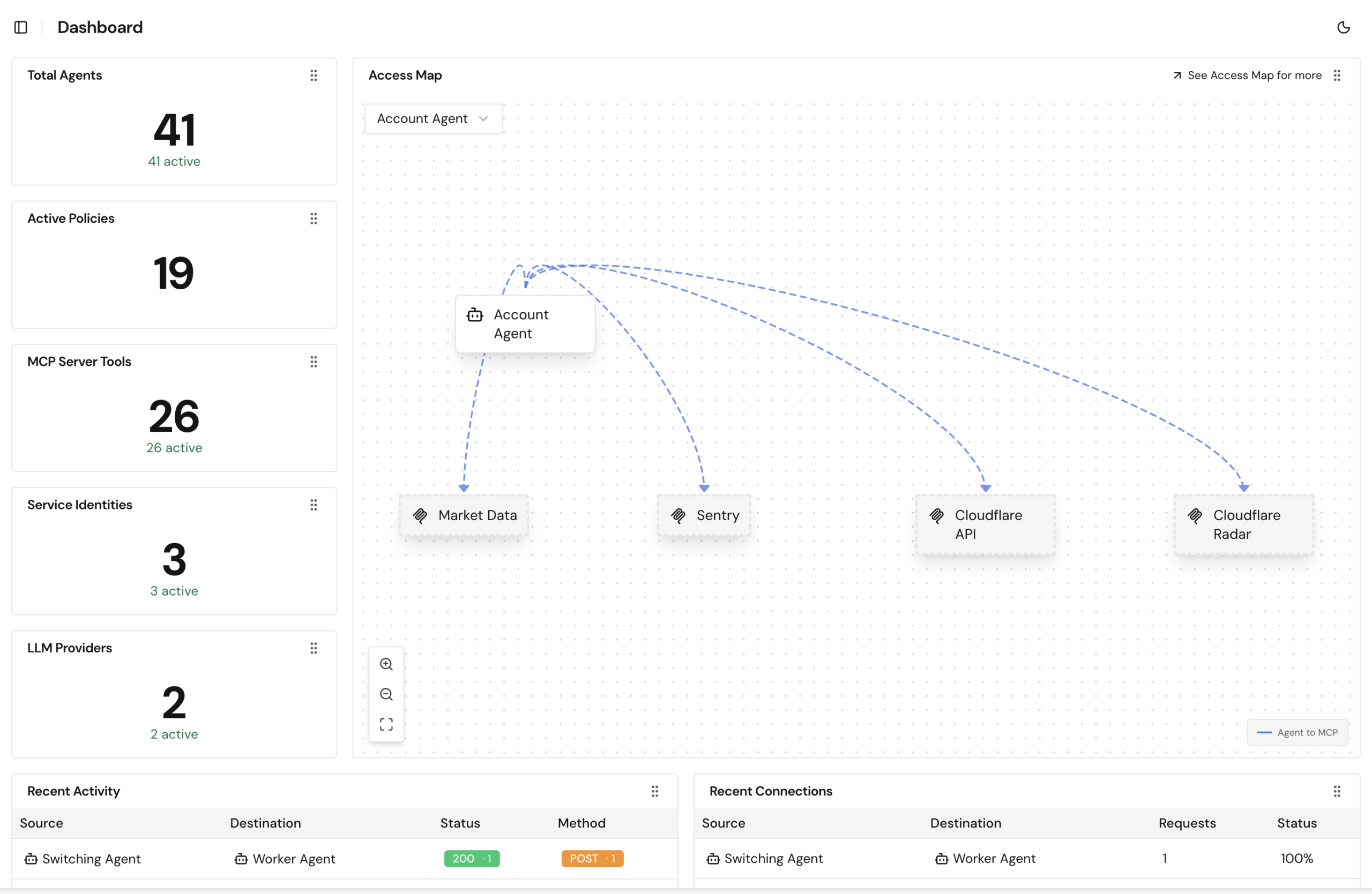 behavior and quarantines suspicious agents.
Source: Tigera
2. Noma Security

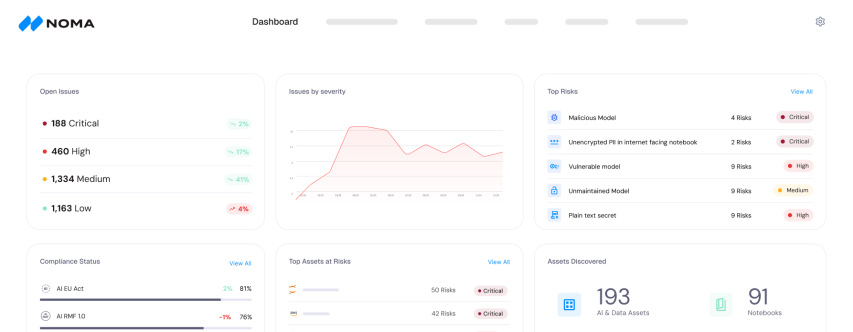
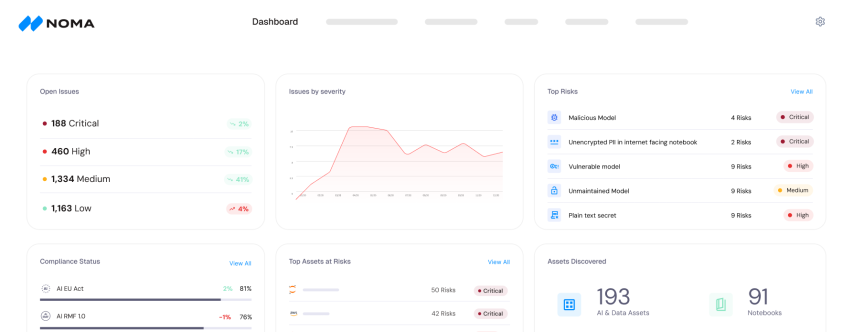
Noma Security provides a unified platform to secure and govern AI systems and autonomous agents across the enterprise. It focuses on delivering end-to-end visibility, posture management, runtime protection, and compliance controls for AI models, agents, and their supporting infrastructure.
Key features include:
- AI security posture management: Continuously discovers AI models, agents, MCP servers, and data sources, mapping dependencies and identifying misconfigurations and risks
- End-to-end AI discovery: Provides visibility into the full AI ecosystem, including how models, agents, and external services connect
- Runtime policy enforcement: Monitors prompts, responses, and tool calls in real time and enforces security, privacy, and compliance policies
- Prompt injection and jailbreak protection: Detects and blocks AI-specific attack vectors through continuous testing and runtime controls
- AI supply chain governance: Defines approved models, tools, and servers to establish a controlled AI supply chain
- Integrated red teaming: Continuously validates AI systems against risks such as data leakage and manipulation
Source: Noma Security
3. WitnessAI

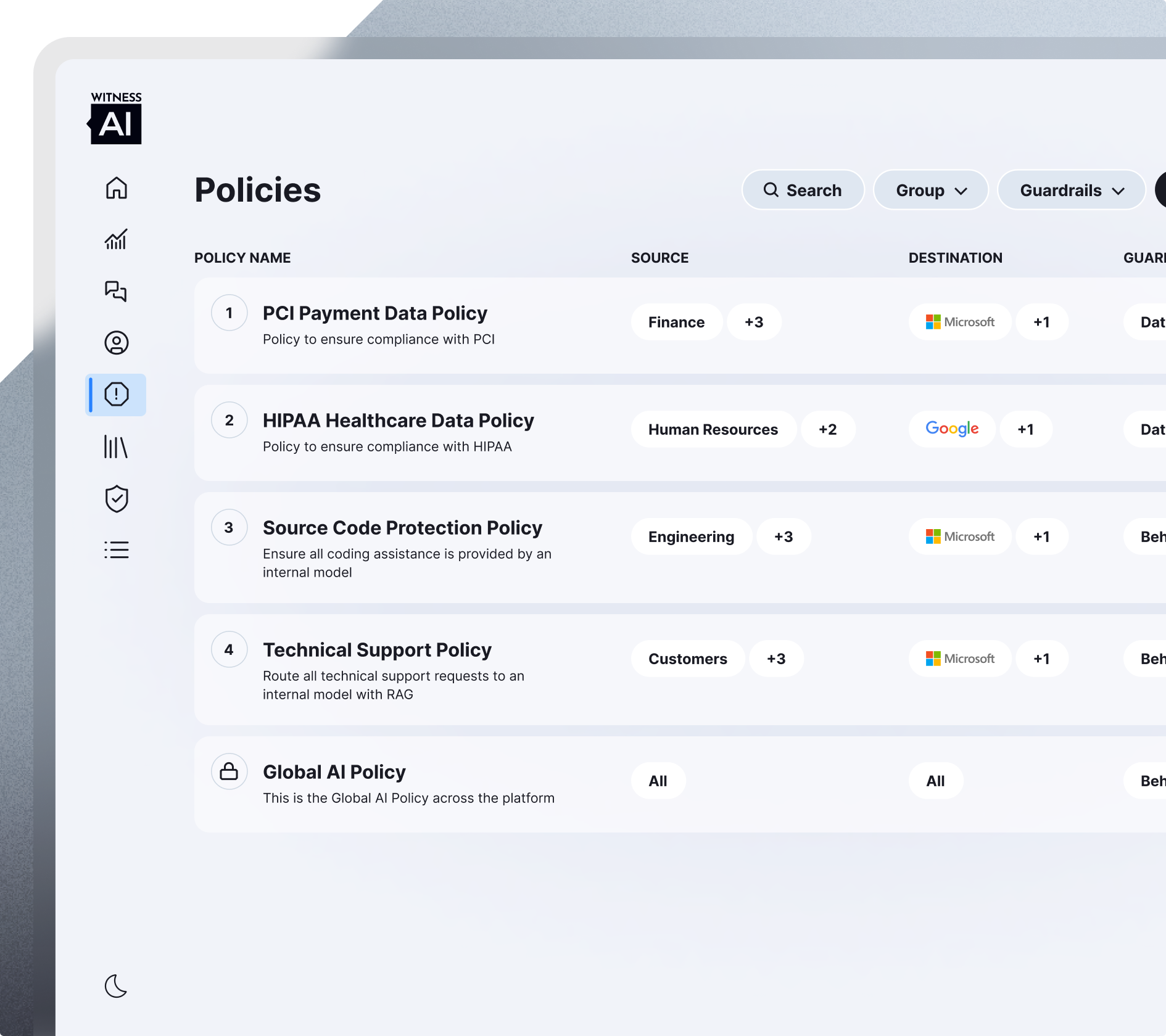
WitnessAI delivers a unified AI security and governance platform that provides network-level visibility and protection across employees, AI models, applications, and autonomous agents. It focuses on securing AI interactions without relying on endpoint agents or browser extensions, instead operating at the network layer to monitor, control, and protect AI usage across the enterprise.
Key features include:
- Network-level visibility: Monitors AI activity across the entire network, including native desktop AI applications, without endpoint clients
- AI footprint discovery: Scans for AI tools and agents in use, cataloging applications and identifying associated risks
- Runtime AI defense: Blocks prompt injection and other attacks before they reach models and filters harmful outputs before delivery
- Intent-based classification: Uses machine learning to analyze conversational context and detect suspicious intent across sessions
- Comprehensive guardrails: Applies data tokenization, model protection, and agent governance rules to reduce misuse and leakage
Source: WitnessAI
4. CyberArk

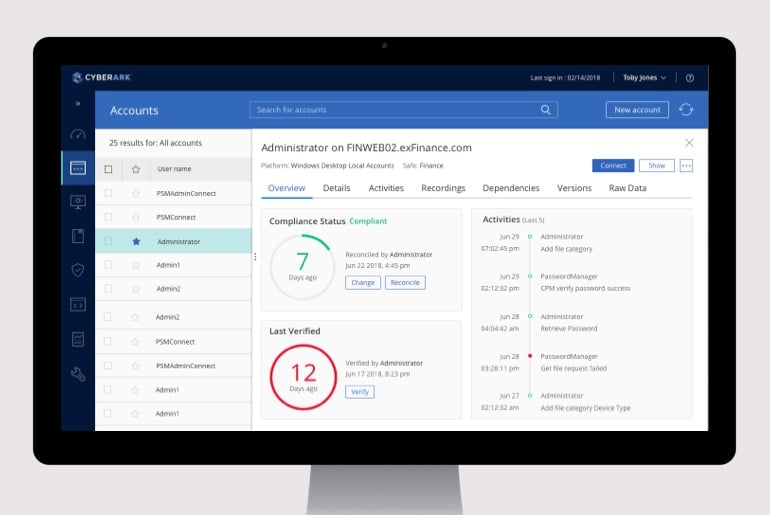
CyberArk Secure AI Agents applies an identity-first approach to securing autonomous AI agents. The platform treats AI agents as a new class of privileged identities and focuses on discovery, privilege control, lifecycle management, and threat detection to reduce risks associated with over-permissioned or unmanaged agents.
Key features include:
- AI agent discovery and context enrichment: Identifies AI agents across SaaS, cloud, and developer environments and enriches them with ownership, purpose, and permission data
- Privilege enforcement gateway: Uses an AI Agent Gateway to grant task-specific access and automatically revoke privileges, minimizing standing access
- Zero standing privileges: Ensures agents receive only the minimum privileges required for a defined task and only for the necessary duration
- Lifecycle management and audit logging: Tracks agent onboarding, management, deprovisioning, and logs actions for auditability
- Threat detection and response: Flags abnormal agent behavior and enables rapid suspension or shutdown of suspicious agents
- Observability tooling: Provides visibility into LLM interactions and tool calls for monitoring and analysis
Source: CyberArk
5. Sailpoint Agent Identity Security
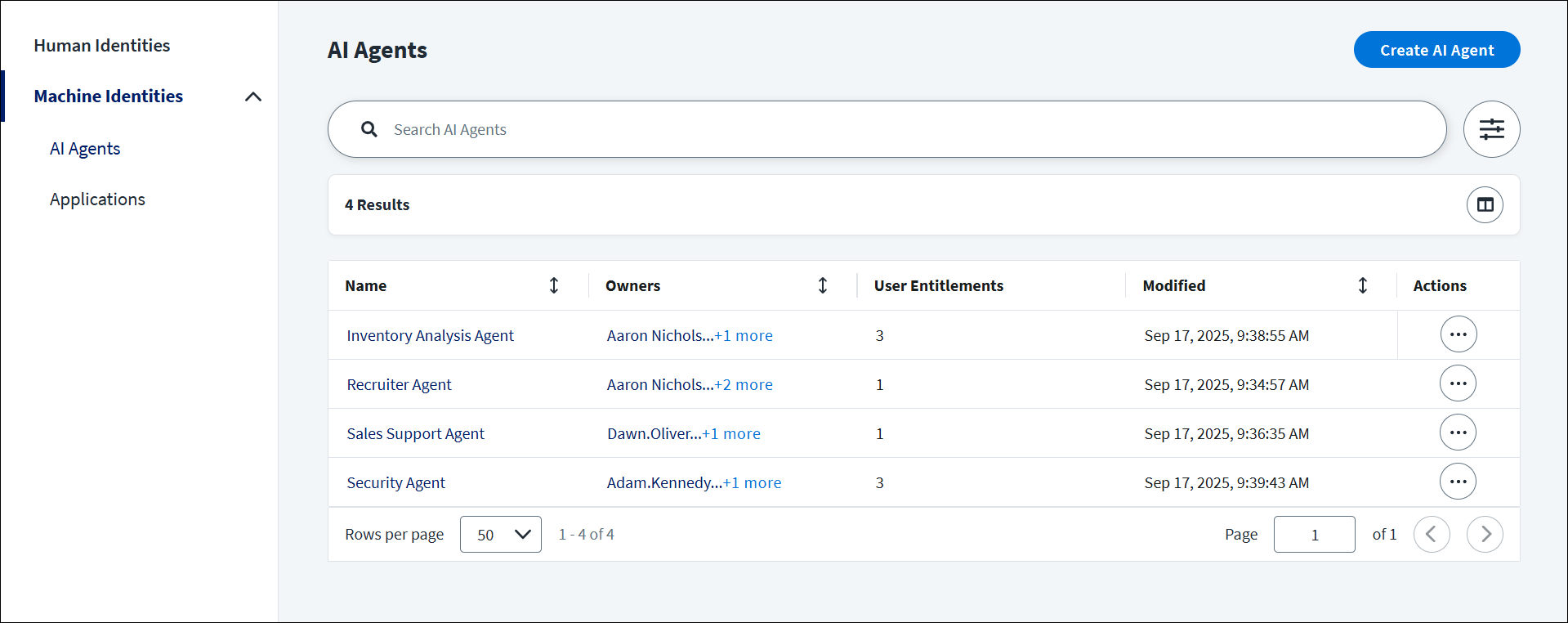
SailPoint Agent Identity Security extends identity governance to AI agents by treating them as governed identities within the broader identity security framework. It aggregates AI agents from cloud platforms and applications, assigns ownership, and enforces access reviews to reduce risk associated with over-permissioned or unmanaged agents.
Key features include:
- Centralized AI agent inventory: Aggregates AI agents from platforms such as AWS, Azure, Google Cloud Platform, and Salesforce into a unified view
- Unique agent identities: Registers each AI agent with a distinct identity enriched with business and access context
- Ownership assignment: Designates one or multiple human owners for accountability and traceability
- Automated ownership updates: Aligns agent ownership with role changes to prevent governance gaps
- Access review and revocation: Enables periodic review of agent permissions and removal of excessive or inappropriate access
- Unified identity governance: Integrates AI agents into broader identity security programs covering human and machine identities
Source: SailPoint
Related content: Read our guide to Agentic AI security
How to Choose AI Agent Security Providers
Here are some of the main considerations when selecting an AI agent security tool.
Deployment Model and Integration
Evaluate how the platform integrates with your existing AI stack, cloud providers, identity systems, and DevOps pipelines. The solution should support your deployment model, whether agents run in SaaS platforms, Kubernetes clusters, on-premises systems, or hybrid environments.
Look for API-first architectures and compatibility with SIEM, SOAR, and identity providers. Poor integration increases operational overhead and limits visibility across the agent lifecycle. Ensure the tool can be deployed with minimal architectural changes and does not disrupt existing development workflows.
Coverage Across the AI Lifecycle
Security should span discovery, development, deployment, and runtime operations. Some providers focus mainly on runtime defense, while others emphasize posture management or identity governance.
Choose a platform that aligns with your risk profile. Organizations with rapid experimentation may prioritize discovery and posture management, while production-heavy environments may require stronger runtime controls and guardrails. End-to-end lifecycle coverage reduces blind spots as agents move from prototype to production.
Identity and Privilege Controls
AI agents act autonomously and often require access to sensitive systems. The provider should support strong machine identity management, least-privilege access, and automated credential rotation. It should also integrate with existing identity governance and privileged access management frameworks.
Assess whether the solution can detect privilege escalation, unmanaged credentials, and excessive permissions. Identity-first security reduces the blast radius of compromised agents. Granular, time-bound access policies are critical to limiting standing privileges.
AI-Specific Threat Protection
Traditional security tools do not fully address prompt injection, jailbreak attempts, model manipulation, or data leakage via LLM interactions. Ensure the provider offers protections designed specifically for agentic AI risks.
Look for runtime prompt inspection, tool call validation, response filtering, and adversarial testing capabilities. AI-native threats require AI-aware defenses. Continuous red teaming and automated attack simulation further strengthen resilience against emerging AI threats.
Deploying an AI gateway in front of agent traffic adds a consistent inspection and policy enforcement point for prompts, tool calls, and model responses, making it easier to apply these AI-specific protections uniformly across environments.
Visibility and Forensics
Comprehensive logging and traceability are essential. The platform should provide clear visibility into agent decisions, tool usage, API calls, and data access patterns. Logs should be structured and exportable for integration with enterprise monitoring tools.
Strong investigation tools help reconstruct incidents and support compliance audits. Without detailed telemetry, it is difficult to understand or contain agent-driven security events. Detailed audit trails also support accountability and regulatory reporting requirements.
Governance and Policy Management
Enterprises operating multiple agents need centralized governance. The provider should enable unified policy definition, enforcement, and reporting across all agents and environments. Policy frameworks should support role-based controls and environment-specific rules.
Policy updates must propagate quickly as threats evolve. Strong governance ensures consistency, reduces configuration drift, and supports regulatory compliance at scale. Automated policy validation helps ensure agents remain aligned with internal standards and external regulations.
Conclusion
As AI agents become more capable and autonomous, the risks they introduce grow in complexity and scale. AI agent security providers are emerging as critical enablers of safe deployment, offering specialized tools to manage threats, enforce guardrails, and maintain compliance. Their role will only become more central as enterprises increasingly rely on agentic systems for mission-critical workflows, making security-by-design a prerequisite for successful adoption.