







What Is an LLM Gateway?
An LLM gateway is a middleware layer that acts as a central hub for applications to interact with one or more Large Language Models (LLMs). It simplifies development and management by providing a single, unified API, handling tasks like routing requests, security, authentication, and cost optimization. This allows developers to use various LLMs without needing to rewrite code for each provider and ensures scalability and control over the interactions.
Key functions and benefits include:
- Unified API: Presents a single, consistent API to your application, abstracting away the complexities of individual LLM providers and their unique APIs.
- Provider agnosticism: Enables you to connect to and switch between different LLMs (like those from OpenAI, Anthropic, and Google) without changing your application’s code.
- Centralized management: Manages tasks like authentication, API key rotation, and rate limiting in one place.
- Scalability and reliability: Handles high-throughput workloads, provides load balancing, and can implement failover mechanisms to ensure the application remains available even if a provider is down.
- Observability and monitoring: Offers a single point for monitoring usage, performance, and costs across all connected models.
- Network-level identity and access control: An LLM gateway acts as a gatekeeper between internal systems and external LLM providers.
- Enhanced security and governance: Enforces security policies and data governance standards consistently across all LLM interactions.
- Cost optimization: Can route requests to the most cost-effective model based on factors like speed and performance.
This is part of a series of articles about LLM security.
In this article:
- Key Functions and Benefits of an LLM Gateway
- How Does an LLM Gateway Work?
- LLM Gateway vs LLM Router: Key Differences Explained
- Challenges and Limitations of Current LLM Gateways
- Network Security Requirements for LLM Gateways
- Notable LLM Gateway Solutions
- LLM Gateway Best Practices for Kubernetes and Cloud Deployments
- How to Evaluate an LLM Gateway for Modern Cloud and Kubernetes Environments
Key Functions and Benefits of an LLM Gateway
1. Unified API
An LLM gateway exposes a unified API that standardizes the way applications communicate with LLMs, regardless of the underlying provider or deployment. Developers interact with a single API format instead of adapting to the unique interfaces, endpoints, and payload structures required by each vendor. This approach speeds up implementation and minimizes changes in client code when switching LLM providers or adding new ones.
A unified API abstracts away differences in request parameters, authentication mechanisms, and response formats. This consistency ensures smoother workflow integration and reduces the learning curve for teams working with multiple LLMs. It also simplifies documentation and internal development processes, since the gateway acts as the central specification for all LLM-related interactions within an organization.
2. Provider Agnosticism
LLM gateways enable true provider agnosticism by decoupling application logic from any single LLM vendor. By routing requests through the gateway, organizations can use multiple LLMs (proprietary, open-source, or self-hosted) without refactoring application code or embedding provider-specific logic. This flexibility is invaluable as LLM options continue to grow and evolve.
Switching providers or incorporating new models becomes a matter of gateway configuration, not code changes. This reduces vendor lock-in and allows organizations to take advantage of diverse pricing, regional availability, and specialized model features. A provider-agnostic approach also helps ensure business continuity if a single vendor has service disruptions or policy changes.
3. Centralized Management
With an LLM gateway, organizations consolidate access and configuration management in one place. Administrators can establish usage quotas, enforce authentication, and manage API keys from the gateway instead of coordinating policies across multiple providers. This centralization simplifies audits, onboarding, and user lifecycle management, offering fine-grained control over who can use which models and under what conditions.
Centralized management also supports policy enforcement and compliance checks. Organizations gain visibility into how LLMs are being used and can enforce best practices for data privacy, rate limiting, or request inspection. This reduces operational risk and makes it easier to adhere to internal or regulatory requirements around AI usage.
4. Scalability and Reliability
LLM gateways handle high request volumes and distribute traffic across multiple model endpoints or providers. They manage request queuing, throttling, and failover, ensuring reliability even during peak loads or partial outages. By abstracting the underlying LLM infrastructure, the gateway can implement strategies to automatically reroute traffic when a provider is overloaded or unavailable.
This architecture supports scaling, whether the goal is to serve more users or to leverage new models as they become available. Applications stay responsive and resilient without direct code changes to account for load balancing or redundancy concerns. As usage grows, the gateway infrastructure can scale horizontally to meet demand, preserving service level targets.
5. Observability and Monitoring
Effective LLM gateways provide observability features, capturing detailed metrics on request rates, response times, error codes, and usage patterns. Centralized monitoring enables tracking of individual requests, overall usage trends, and model-specific performance, improving incident detection and troubleshooting capability.
Real-time dashboards, alerting, and log aggregation are often integral to LLM gateways. These observability features help diagnose performance bottlenecks, monitor cost drivers, and ensure that service-level agreements are met. Security and compliance teams also benefit from complete audit trails of all LLM interactions, supporting investigations and reporting.
6. Network-Level Identity and Access Control
An LLM gateway enforces network-level identity and access control by acting as a gatekeeper between internal systems and external LLM providers. It supports IP allowlisting, mutual TLS, and integration with identity-aware proxies to ensure that only authorized systems and users can send requests through the gateway. This reduces exposure of LLM APIs to untrusted networks and minimizes attack surfaces.
The gateway can also authenticate individual services or users through API tokens, service accounts, or OAuth, and enforce role-based access control (RBAC) or attribute-based access control (ABAC) policies. By centralizing these mechanisms, it ensures consistent access controls across all model interactions, preventing misuse and supporting zero trust security principles.
These capabilities help isolate LLM traffic from the public internet, enforce internal segmentation, and ensure that only sanctioned users or services can invoke model endpoints, critical for enterprise environments handling sensitive or regulated data.
7. Enhanced Security and Governance
LLM gateways improve security by acting as an enforcement layer for authentication, authorization, and data protection policies. They can integrate with enterprise identity systems, apply fine-grained access controls, and inspect data payloads before requests reach external LLMs. This prevents unauthorized access and helps organizations apply consistent security standards across all LLM usage.
Enhanced governance extends to support for audit logging, privacy policies, and API usage limits. The gateway can redact, encrypt, or mask sensitive data as required, reducing compliance risk and enabling safer external model consumption. Centralized policy enforcement minimizes the risk of accidental data leaks or misuse of AI services.
8. Cost Optimization
A key function of LLM gateways is to enable cost optimization by tracking and controlling usage at both the application and user levels. The gateway can monitor token and request consumption in real time, apply usage policies, and alert administrators when spending thresholds are reached. This detailed insight into cost drivers makes budgeting and forecasting LLM expenses more predictable.
Cost optimization features often include automated usage caps, routing to less expensive providers, or performance benchmarking to select the most cost-effective model for a given workload. By providing these controls centrally, the gateway helps organizations prevent runaway costs and make informed decisions about when to scale up or down LLM utilization.
How Does an LLM Gateway Work?
An LLM gateway acts as an intermediary layer between client applications and one or more large language model backends. When an application sends a request, the gateway receives it first, processes it according to internal rules, and then forwards it to the appropriate LLM provider or deployment.
The gateway handles request transformation, which may include normalizing inputs, adding authentication tokens, or adjusting parameters to match the expected format of the target model. Once the LLM returns a response, the gateway can post-process the output, such as filtering content, logging metadata, or formatting the response, before returning it to the application.
- Routing logic: Based on configuration, request context, or performance metrics, the gateway decides which model to use for each request. It can route traffic based on model type, provider cost, availability, or custom business rules. For example, it might use a faster, cheaper model for autocomplete tasks and a larger, more accurate model for summarization.
- Security and governance: The gateway inspects requests for compliance with access control policies, logs activity for auditing, and ensures data is handled according to organizational standards. Observability tools built into the gateway track metrics like latency, token usage, and error rates.
Internally, the gateway may use plugins, policies, or service mesh patterns to support extensibility and multi-tenant isolation. It often integrates with enterprise systems for identity, logging, and monitoring. This modular architecture allows teams to adapt the gateway’s behavior without modifying client applications or backend models.
LLM Gateway vs LLM Router: Key Differences Explained
While both LLM gateways and LLM routers sit between clients and large language models, they serve different purposes and operate at different levels of abstraction.
An LLM gateway is a broader platform component that provides centralized management, unified access, and security enforcement across multiple LLM providers or deployments. It standardizes how clients interact with language models, handling authentication, rate limiting, observability, and policy enforcement. The gateway acts as the primary interface for developers, abstracting all underlying complexity and offering a single point of integration for the entire organization.
An LLM router is a more focused mechanism within or alongside a gateway that directs traffic to the most appropriate model based on dynamic conditions. Routing decisions can be based on request metadata, model availability, latency, cost, workload type, or user-defined rules. The router enables intelligent selection of models, for example, directing summarization tasks to a large model and chat tasks to a faster, smaller one.
In short:
- The LLM gateway is concerned with system-wide access, governance, and standardization.
- The LLM router is responsible for decision-making about which model instance to use per request.
Challenges and Limitations of Current LLM Gateways
Lack of Consistent Network-Layer Enforcement
Many LLM gateways rely heavily on application-layer controls while lacking robust enforcement at the network layer. This can lead to gaps where unauthorized services or endpoints bypass gateway policies by making direct API calls to LLM providers. Without support for mechanisms like network-level allowlisting, mutual TLS enforcement, or integration with identity-aware proxies, the gateway’s ability to enforce segmentation and secure data boundaries remains limited.
This becomes critical in environments with strict compliance needs or internal network segmentation requirements. Effective LLM gateway deployment often requires complementary network security infrastructure to ensure that all traffic to external models is mediated and logged.
Inconsistent or Missing Egress Controls to External LLMs
Gateways often lack fine-grained controls over egress traffic, making it difficult to restrict what data leaves the network and to which model providers. This is a significant challenge for organizations handling regulated or sensitive data, where outbound traffic must comply with data residency, classification, or provider-specific restrictions.
Without native egress filtering and routing policies, teams must implement ad hoc network-level controls that are harder to maintain and audit. Effective gateways should offer built-in features for enforcing data exfiltration policies, including allow/deny lists for specific domains or models and rules based on data sensitivity.
Gaps in Observability Across Multiple Workloads
While LLM gateways typically offer basic metrics like token usage and latency, observability often breaks down in multi-tenant or polyglot environments. It becomes difficult to trace specific prompts or performance issues back to their origin, especially when workloads span multiple microservices, teams, or business units.
This lack of granularity hampers root cause analysis and makes cost attribution unreliable. Gateways should support structured, per-request telemetry with contextual metadata, such as service ID, tenant, or business function, to provide complete visibility into how and where LLMs are being used.
No Built-In Zero Trust for LLM Traffic
Most LLM gateways do not natively enforce zero trust principles for inbound or outbound LLM traffic. They often assume trust in internal callers or allow traffic based on static configurations, without verifying the identity, purpose, or risk profile of each request.
To implement true zero trust for LLMs, gateways must integrate with identity systems and enforce dynamic access controls based on context. This includes validating who or what is calling the gateway, assessing request intent, and applying least-privilege principles to both input and output flows.
Limited Visibility Across Kubernetes Microservices Accessing LLMs
In Kubernetes environments, microservices often communicate with LLM gateways without proper tagging or tracing, making it hard to determine which services are generating which requests. This lack of service-level visibility hinders debugging, auditing, and cost allocation.
Gateways should integrate with service mesh technologies or Kubernetes-native constructs (like labels and annotations) to trace LLM usage per pod, namespace, or deployment. Without this, organizations risk blind spots in monitoring and governance, especially in shared clusters.
Inability to Assign Static IPs for External Compliance
Many LLM gateways do not support egress through static IPs, which is often required for enterprise compliance with data access controls or for allowlisting traffic with external vendors. Without this, organizations may be unable to prove where LLM traffic is coming from, or meet partner security requirements.
This limitation also complicates interactions with model providers that require source IP allowlisting. Gateways should offer support for NAT gateways, static egress IP pools, or private networking extensions to meet these compliance needs.
Network Security Requirements for LLM Gateways
Identity-Aware Microsegmentation
Microsegmentation divides a network into fine-grained zones and ensures only authorized entities communicate across them. In an LLM gateway context, identity-aware microsegmentation means that each service or user must present valid credentials (e.g., mTLS certificates or identity tokens) before sending requests to the gateway or between internal services.
This prevents lateral movement inside the network and ensures LLM calls originate only from known, authorized sources. By enforcing segmentation based on identity rather than just IP or subnetwork, organizations can isolate high-risk workloads (e.g., handling sensitive data) from lower-risk ones. This also enables per-tenant or per-team isolation in multi-tenant setups.
L7 and L3/L4 Enforcement for LLM-Bound Traffic
To fully secure traffic to and from LLM providers, enforcement should happen both at the network layer (L3/L4) and application layer (L7). On L3/L4, firewalls or network policies enforce that only gateway instances can egress to external LLM endpoints, blocking any direct call attempts from arbitrary hosts. This prevents unauthorized services from bypassing gateway controls.
At L7 (the application layer), the gateway should inspect each request’s protocol, content type, and metadata. For example, it can verify that the request originates from an allowed internal service, or enforce payload validation rules. This combined enforcement model ensures that even if network security is bypassed at one layer, the other layer still applies controls.
Token Logging and Network Logs Correlation
For auditing and governance, the gateway must log every request and correlate those logs with network-level metadata. Each LLM request should record identity (service or user), timestamp, model used, token usage, and request purpose. Meanwhile, network logs (e.g., firewall or proxy logs) should capture source IP, destination endpoint, port, and transport protocol.
By correlating these two streams (application-level logs and network-level logs) administrators can reconstruct full end-to-end flows. This helps detect anomalies (e.g., unexpected sources of LLM traffic), support incident investigations, and satisfy compliance requirements. Structured and centralized logging (e.g., JSON-based logs forwarded to SIEM) improves traceability.
Governance Requirements for Regulated Industries
Organizations in regulated sectors (e.g., healthcare, finance, government) often face strict rules for data residency, access control, auditing, and data retention. An LLM gateway must support these governance requirements out-of-the-box. That includes enforcing data classification policies (e.g., blocking or redacting sensitive data), restricting which models or providers can be used for regulated data, and ensuring logs are immutable and retained per compliance policies.
The gateway should allow policy-as-code mechanisms to define who can invoke which models, under what circumstances, and whether output can be stored or forwarded. It should support secure data handling (encryption in transit and at rest), and provide audit trails that satisfy external audits.
Secure Connectivity for Self-Hosted and Cloud Models
When the gateway routes requests to both self-hosted models (on-prem or private cloud) and cloud-hosted providers, it must secure connectivity appropriately. For cloud models, traffic should flow over encrypted channels (e.g., TLS), ideally via private network links or VPNs when possible to avoid exposure on public internet.
For self-hosted models, the gateway should connect over internal networks or secure tunnels. The gateway configuration should also support private egress (e.g., using NAT gateways, static IPs, or VPC/VNet peering) to comply with allow‑listing requirements from external LLM providers or internal compliance policies.
Notable LLM Gateway Solutions
1. Tigera Lynx

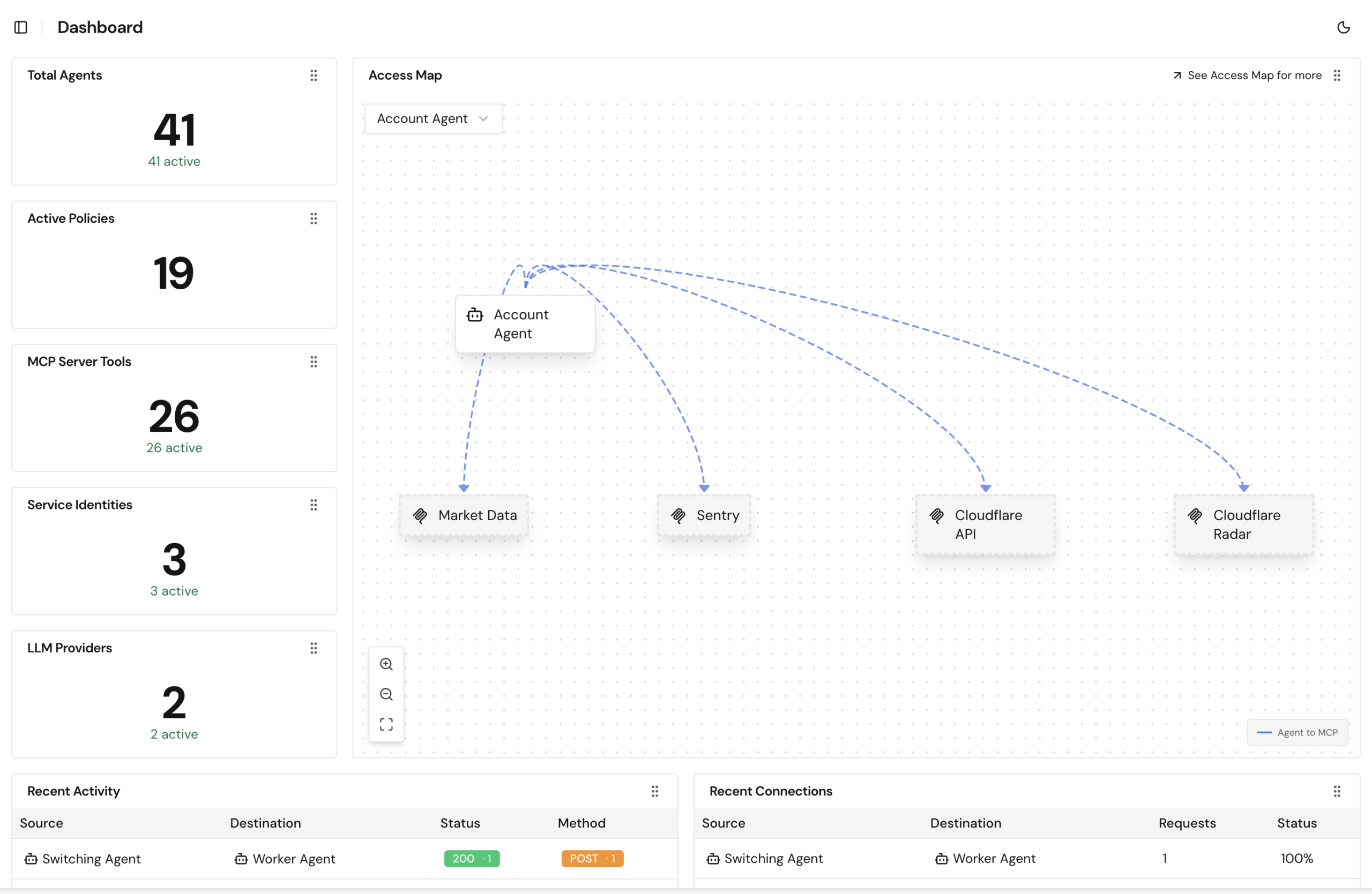
Tigera provides Lynx, a unified control plane for Kubernetes-native AI agents. Lynx sits in the path of every agent call (agent-to-agent, agent-to-tool, and agent-to-LLM) to authenticate, authorize, mediate, and audit each one. It gives enterprises a single place to find every agent in their Kubernetes estate, tighten posture, assign a sandbox, give each agent cryptographic identity, enforce policy on every action it takes, audit what agents actually do and detect anomalous behavior. Lynx plugs into the tools enterprises already run, including their identity provider (EntraID, Okta) or via SPIFFE/SPIRE, and existing observability systems, and is built on open standards rather than proprietary lock-in.
Key features include:
- Discovery, registration, and observability: A central registry catalogs every agent with its owner, purpose, and version, while eBPF-powered auto-discovery finds agents nobody registered. Shadow agents are flagged and quarantined, and any agent’s actions can be reconstructed end-to-end through OpenTelemetry traces.
- Configuration and posture management: AI-CSPM continuously evaluates every agent against a baseline, surfacing drift and over-permissions the moment they happen, with per-agent sandboxing and pre-built compliance packs mapping to GDPR, HIPAA, SOC 2, and financial services requirements. A Red Team Agent continuously probes for weaknesses in posture and misconfigurations.
- Identity and authentication: Every agent gets a verifiable cryptographic identity through integration into an enterprise’s identity provider (EntraID, Okta) or through SPIFFE/SPIRE, with no shared secrets. Long-lived API keys are replaced by short-lived and tightly scoped, auto-rotated tokens. A JWT token is minted for every hop in a multi-agent workflow.
- Policy definition and enforcement: A single default-deny policy governs LLM, MCP, and agent access using the Cedar policy language, enforced at the gateway before any call executes — with no agent code changes. Misbehaving agents can be quarantined instantly and high-stakes calls routed to a human.
- Anomalous behavior detection: eBPF and LSM watch every syscall, network call, and file access at a layer agents can’t tamper with, catching credential theft and lateral movement even when an action passes policy. This provides a forensic audit trail. Guardian Agent detects anomalous behavior and quarantines suspicious agents.
Source: Tigera
2. LiteLLM Proxy (LLM Gateway)

LiteLLM Proxy is an OpenAI-compatible LLM gateway that allows developers and platform teams to interact with over 100 different LLMs through a standardized API interface. It serves as a centralized service for routing, managing, and observing LLM traffic, making it easier to scale generative AI usage across organizations. Acting as a drop-in proxy layer, it simplifies integration with providers like OpenAI, Azure, Anthropic, VertexAI, and Hugging Face.
Key features include:
- Unified API interface: Supports a single OpenAI-compatible API across 100+ LLM providers for chat, completion, embedding, transcription, speech, and image generation.
- Cost tracking & budget controls: Tracks token usage and costs per project or user; supports budget caps and spend alerts.
- Retry & fallback routing: Implements router logic for automatic failover across multiple deployments (e.g., OpenAI, Azure), improving reliability.
- Centralized logging & observability: Exposes input/output logs via callbacks to tools like MLflow, Langfuse, Helicone, and Lunary for detailed monitoring.
- Custom guardrails: Offers hooks for authentication, request validation, and response filtering, allowing project-specific governance.
3. Portkey AI Gateway

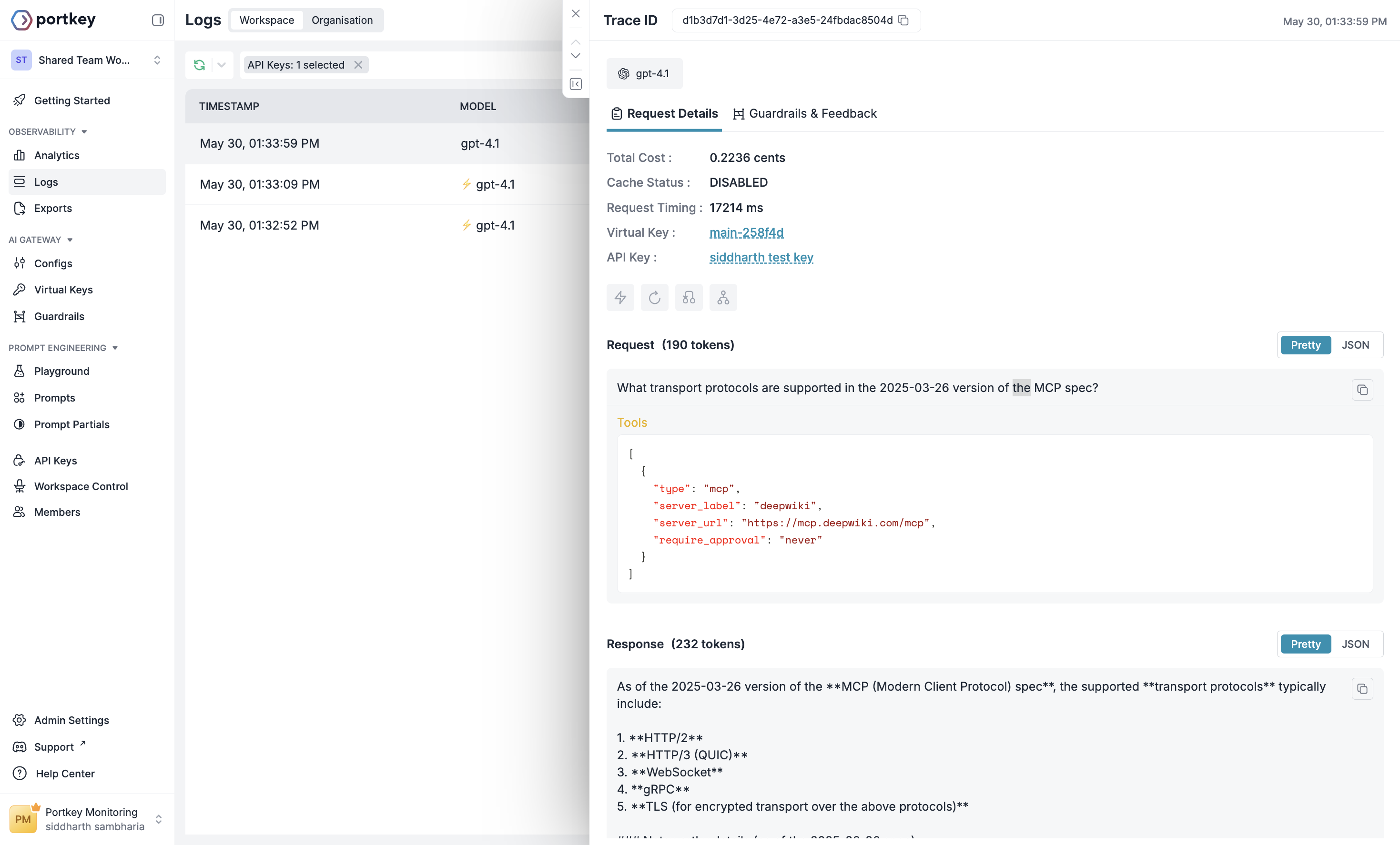
Portkey AI Gateway is an infrastructure layer to connect, manage, and secure interactions with over 1600 LLMs and multimodal AI models. It provides a unified API to simplify integration across providers, while offering controls for performance, cost, and governance. It enables GenAI teams to route traffic, reduce latency with caching, batch requests, and enforce security policies.
Key features include:
- Unified access to 1600+ LLMs: Standardized API for text, vision, audio, and image generation models, no need for individual integrations.
- Smart routing & failover: Supports conditional routing, automatic retries, and failover logic to maintain uptime and ensure fast responses.
- Intelligent caching: Offers simple and semantic caching to reduce cost and latency on repeated requests.
- Key vault & virtual keys: Centralized management for API keys with support for rotation, revocation, and per-key usage tracking.
- High volume support: Enables large-scale throughput with smart batching via provider APIs or custom logic, while preserving responsiveness.
Source: Portkey
4. Helicone AI Gateway

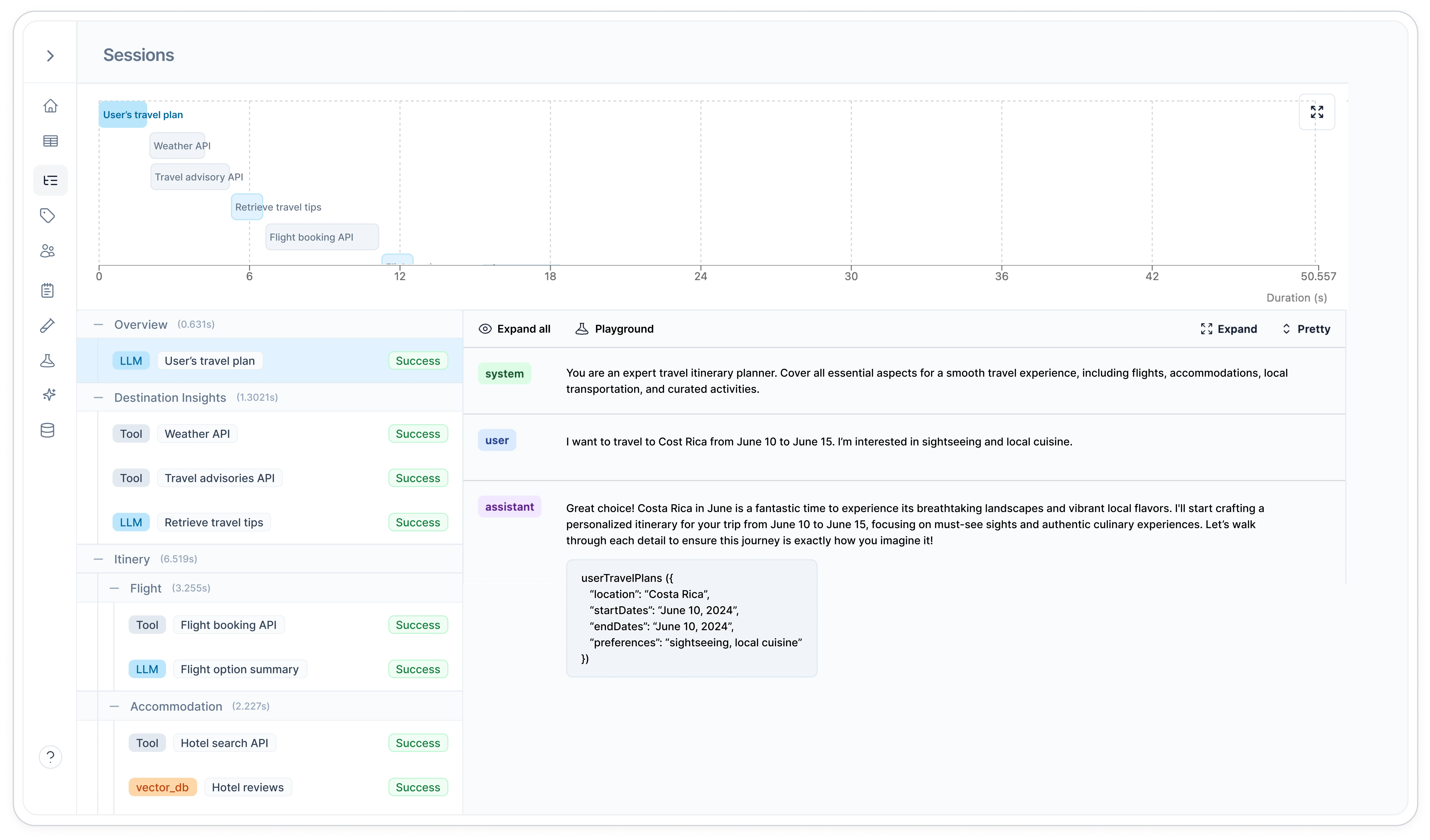
Helicone AI Gateway is a self-hosted routing layer for large language models, built in Rust. Designed for AI teams running multiple models in production, it enables switching between over 100 LLMs using a consistent OpenAI-compatible API, no new dependencies or integration rewrites required.
Key features include:
- Unified API across providers: Route to any supported LLM (Claude, GPT, etc.) using standard OpenAI syntax, no SDK changes required.
- Performance-first architecture: Written in Rust for low latency and high throughput, ensuring stable performance at scale.
- Self-hosted deployment: Deploy on in-house infrastructure for control without depending on Helicone’s uptime or business model.
- Failover and reliability: Automatically reroute requests during provider outages to maintain service continuity.
- Built-in rate limiting: Throttle traffic at the gateway level to protect downstream providers and control usage patterns.
Source: Helicone
5. Kong AI Gateway

Kong AI Gateway is a unified API platform for securely exposing, managing, and optimizing AI traffic across multiple LLM and multi-agent (MCP) systems. Designed for enterprise-grade AI workloads, it provides centralized control over security, routing, caching, and observability, enabling organizations to safely integrate AI into production applications.
Key features include:
- Unified access to multiple LLMs: Supports major AI providers through a single interface, enabling consistent governance and rapid switching between models.
- LLM security and policy enforcement: Implements semantic prompt guards, PII sanitization, and advanced prompt control to protect sensitive data and enforce responsible AI use.
- AI usage visibility: Tracks token-level AI consumption through L7 observability, dashboards, and analytics, helping teams monitor, optimize, and govern AI traffic.
- Cost optimization: Reduces redundant token usage with semantic caching and automatically routes requests to the most cost-effective or appropriate model.
- No-code AI workflows: Integrates AI into existing APIs without writing code, using declarative configuration and no-code plugins for request/response transformation.

Source: Kong
LLM Gateway Best Practices for Kubernetes and Cloud Deployments
Organizations should consider these practices when using an LLM gateway in Kubernetes or cloud environments.
1. Standardize on OpenAI API-Compatible Interfaces
Standardizing on an OpenAI-compatible API layer simplifies development and accelerates integration with multiple LLM providers. Many gateways, including LiteLLM, Helicone, and others, support the OpenAI API format as a de facto standard. This allows teams to build once and run across providers like OpenAI, Anthropic, Azure, Mistral, and Cohere without code changes.
This compatibility also reduces integration friction for developer tooling, client SDKs, and third-party platforms already built around the OpenAI API. In Kubernetes environments, exposing this standardized interface via internal services or ingress controllers enables uniform access patterns and reduces onboarding time for new teams or projects.
2. Implement Fine-Grained Access Control
Apply access control at the gateway level using identity-aware policies that map roles to specific LLM capabilities. Use attribute-based access control (ABAC) or role-based access control (RBAC) tied to service identity, namespace, or team membership. For example, allow one team to access summarization models only, while another can use code-generation models with stricter logging.
In Kubernetes, integrate the gateway with workload identity solutions like SPIFFE/SPIRE, Kubernetes service accounts, or cloud-native IAM. Use policies-as-code frameworks like Open Policy Agent (OPA) to define and enforce fine-grained rules. This prevents unauthorized access and ensures different teams and services only consume appropriate LLM resources.
3. Use Centralized Logging and Real-Time Monitoring
Centralizing logs from all LLM traffic through the gateway enables consistent observability across services, teams, and environments. Configure structured logging (e.g., JSON) to capture metadata like request type, model used, token count, latency, and caller identity. Forward logs to observability platforms such as Grafana Loki, ELK, or a cloud-native logging stack for unified querying and analysis.
Real-time monitoring should include dashboards with metrics on success/error rates, token usage trends, and cost breakdowns by team or project. Alerts can be set for abnormal spikes in traffic, failures, or cost thresholds. Integrating logging with distributed tracing tools helps debug model behavior across service boundaries in microservice-based applications.
4. Benchmark Across Models and Track Cost per Token
Implement systematic benchmarking to evaluate model performance across providers and workloads. Use standardized prompts and measure latency, accuracy, and token cost. This enables data-driven decisions about which models to use for different use cases, such as summarization, classification, or code generation.
Track token-level usage and cost attribution at the team, project, and user levels. Gateways should expose APIs or dashboards to query real-time token consumption, allowing engineering and finance teams to monitor trends and forecast budgets. Combine cost data with performance metrics to choose models that strike the right balance for your workload.
5. Automate Failover and Multi-Region Redundancy
Configure your LLM gateway to automatically retry failed requests using fallback providers or model variants. Use health checks and latency-based routing to detect provider outages or degradations, and switch traffic accordingly. For mission-critical workloads, define tiered routing policies: e.g., try a preferred model first, then fallback to a backup with acceptable performance.
In global deployments, replicate gateways across multiple regions and sync configuration through GitOps or CI/CD pipelines. Use multi-region failover to maintain availability during regional outages. This ensures low latency for geographically distributed users and resilience against localized disruptions.
6. Implement Network-Level Egress Controls for LLM Traffic
Control outbound traffic from the gateway using Kubernetes network policies, service meshes (e.g., Istio), or cloud-native firewalls. Restrict egress to only approved LLM endpoints, preventing unauthorized services from sending traffic directly to providers. Use DNS filtering or IP allowlists to enforce strict egress boundaries.
ensures that all LLM traffic passes through the gateway for proper logging, access control, and cost tracking. It also supports compliance with data residency and provider-specific policies by preventing data from leaving approved zones or hitting unauthorized APIs.
7. Enforce Least-Privilege Policies for Workloads Accessing LLMs
Apply strict authentication and authorization to services invoking the LLM gateway. Use service accounts, workload identity, or mTLS to authenticate internal clients, and enforce role-based access control (RBAC) to restrict which models or operations each service can perform.
For example, limit write or generation permissions to trusted workloads and provide read-only access (e.g., embeddings, classification) to less sensitive services. Enforcing least-privilege principles reduces the attack surface and prevents unintentional overuse or misuse of expensive or sensitive LLM functionality.
8. Prevent “Shadow AI” with DNS Policy Enforcement
Prevent unauthorized LLM usage by enforcing DNS policies at the cluster or network level. Block direct DNS resolution to known LLM endpoints (e.g., api.openai.com, api.anthropic.com) and allow access only through the gateway’s DNS records or proxy endpoints.
This prevents “shadow AI”: situations where developers bypass internal governance by integrating directly with external APIs. Enforcing DNS policies ensures that all LLM interactions are mediated by the gateway, preserving observability, security, and cost controls. This is especially important in regulated or shared environments.
How to Evaluate an LLM Gateway for Modern Cloud and Kubernetes Environments
When evaluating an LLM gateway for use in modern cloud-native or Kubernetes-based environments, prioritize infrastructure compatibility, extensibility, and operational controls. A suitable gateway should include the following characteristics:
- Kubernetes-native deployment support: Check for native support for Kubernetes deployments, including Helm charts, Kubernetes manifests, or operator support. The gateway should run as a containerized service, integrate with service meshes like Istio or Linkerd, and support native networking constructs (e.g., NetworkPolicy, ingress controllers, and service discovery). It should also allow easy integration with ConfigMaps, Secrets, and pod-level IAM for secure configuration.
- Identity and access integration: The gateway should integrate with Kubernetes-native identity (e.g., service accounts) and external identity providers (e.g., OIDC, SAML, or workload identity platforms). Support for fine-grained authorization policies is essential, ideally through OPA or similar tools. Look for gateways that can enforce RBAC/ABAC based on Kubernetes namespace, workload, or service annotations.
- Multi-model routing and observability: Support for dynamic routing based on latency, cost, or usage patterns is critical for optimizing performance and budget. Evaluate whether the gateway can perform conditional routing (e.g., task type or payload content) and provide real-time observability into which model is used, how it performed, and what the request cost. Prefer gateways with native support for Prometheus, Grafana, OpenTelemetry, or integration into your existing monitoring stack.
- Network and security controls: Ensure the gateway supports network-layer enforcement, such as egress restrictions, static IPs for outbound traffic, and mTLS. It should help enforce zero trust principles, log all traffic, and integrate with your security stack (e.g., SIEM, DNS policies, firewalls). Built-in support for request validation, payload inspection, and redaction is also key in sensitive environments.
- Cost management features: Look for built-in support for token accounting, usage-based alerting, and per-team/project cost controls. The gateway should allow defining budgets and enforcing caps per user or team. Advanced gateways can provide semantic caching, batch processing, and model benchmarking to reduce costs and optimize performance.
- Extensibility and governance: A strong gateway should offer hooks or plugin frameworks for custom policies, filtering, and auditing. Support for policy-as-code, structured audit logs, and data handling rules ensures alignment with compliance requirements. Evaluate whether it can redact PII, enforce regional model use, and control output logging/storage.
By aligning your evaluation criteria with your organization’s infrastructure and compliance needs, you can ensure the LLM gateway not only scales operationally but also enforces policy, reduces cost, and supports secure AI adoption in production.