Defining API Gateway and Service Mesh
An API gateway manages north-south traffic (external to internal) for public-facing APIs, handling tasks like authentication, rate limiting, and routing to backend services. A service mesh manages east-west traffic (internal service-to-service communication), providing reliability, security (like mTLS), and observability between microservices. While there is overlap in some features like load balancing and observability, they solve different problems: the gateway is the front door, and the service mesh is the internal communication network.
API gateway:
- Purpose: To manage and secure external access to your applications.
- Traffic flow: Primarily handles “north-south” traffic, which is traffic coming from outside the application to the backend services.
Service mesh:
- Purpose: To handle and manage communication between microservices within an application.
- Traffic flow: Manages “east-west” traffic, which is the communication that happens between services internally.
Using API gateway and service mesh together
It is common to use these solutions together within the same architecture. The API gateway acts as the entry point for external traffic, while the service mesh handles the complexity of internal service-to-service communication. This combination provides centralized control for external APIs and robust, secure, and observable communication within the application.
In this article:
- Service Mesh vs. API Gateway: The Key Differences
- Service Mesh Pros and Cons
- API Gateway Pros and Cons
- API Gateway vs. Service Mesh: When to Use Which, and When to Use Both
Service Mesh vs. API Gateway: The Key Differences
1. North-South vs. East-West
A fundamental distinction between API gateways and service meshes is the direction of traffic they handle, commonly described as “north-south” and “east-west” traffic. API gateways deal primarily with north-south traffic, which encompasses requests entering and leaving the application from clients or external systems. By handling tasks like authentication, routing, and rate limiting for these external calls, API gateways simplify and secure the system boundary.
Service meshes focus on managing east-west traffic, which describes communication between services within the application boundary. The mesh automates service-to-service interactions, enforcing policies, and collecting telemetry regardless of the service’s internal location. This focus ensures reliable internal communication but does not address client-facing operations directly.
2. Responsibilities
API gateways handle and secure external API requests, translate protocols, consolidate responses, and often aggregate data from multiple microservices into a single API response for clients. They also act as the gatekeeper, providing features like rate limiting, logging, request validation, and API version management. The primary goal is to manage and optimize access from users or third-party applications to backend services.
Service meshes take on the responsibilities of service discovery, dynamic routing, load balancing, fault injection, retries, and granular observability between internal services. They typically do not provide API aggregation or expose service endpoints to external clients, instead focusing on enforcing security policies and ensuring the resilience and reliability of service-to-service interactions.
3. Architecture and Components
API gateways are usually deployed as a set of centralized or distributed proxy servers positioned at the network perimeter. They function as the main point for inbound traffic, sometimes employing plugins or extensions to offer additional features. The gateway architecture relies on scalability and must be highly available to avoid becoming a single point of failure in application access.
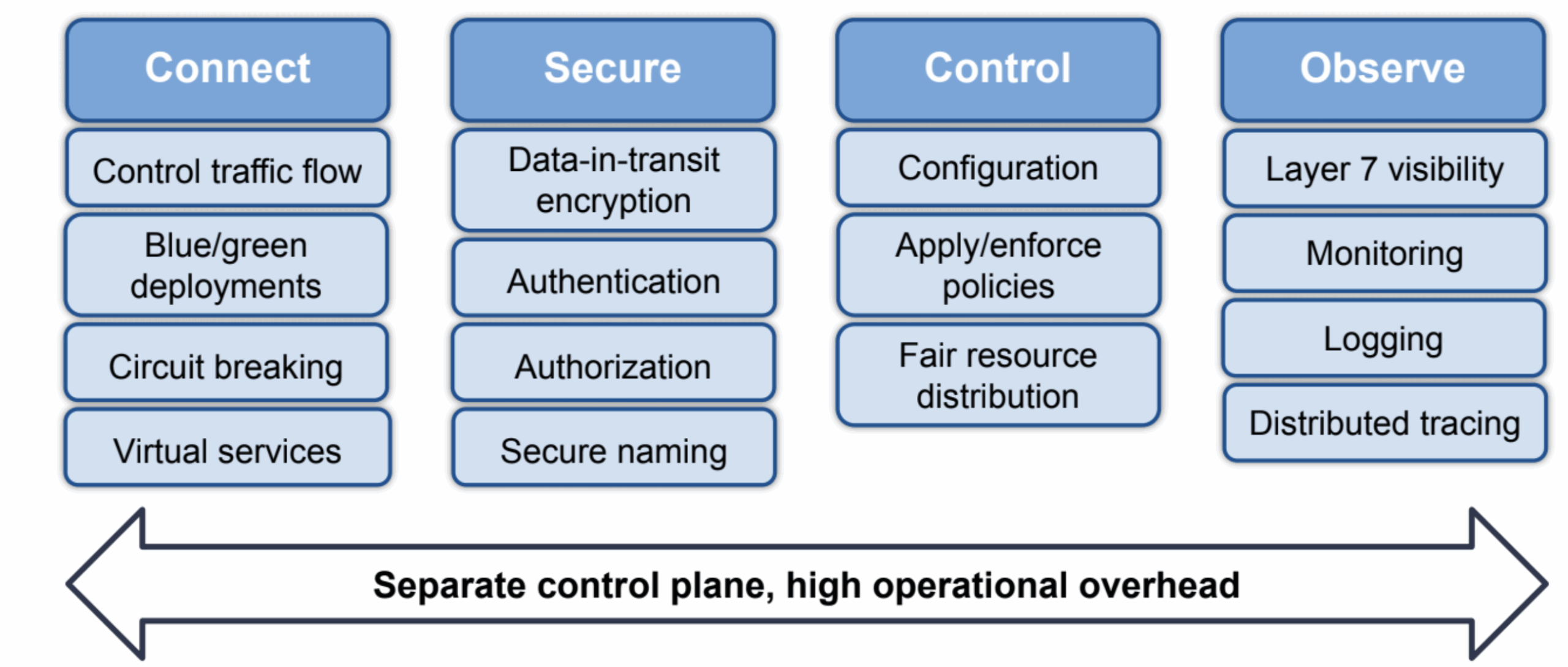
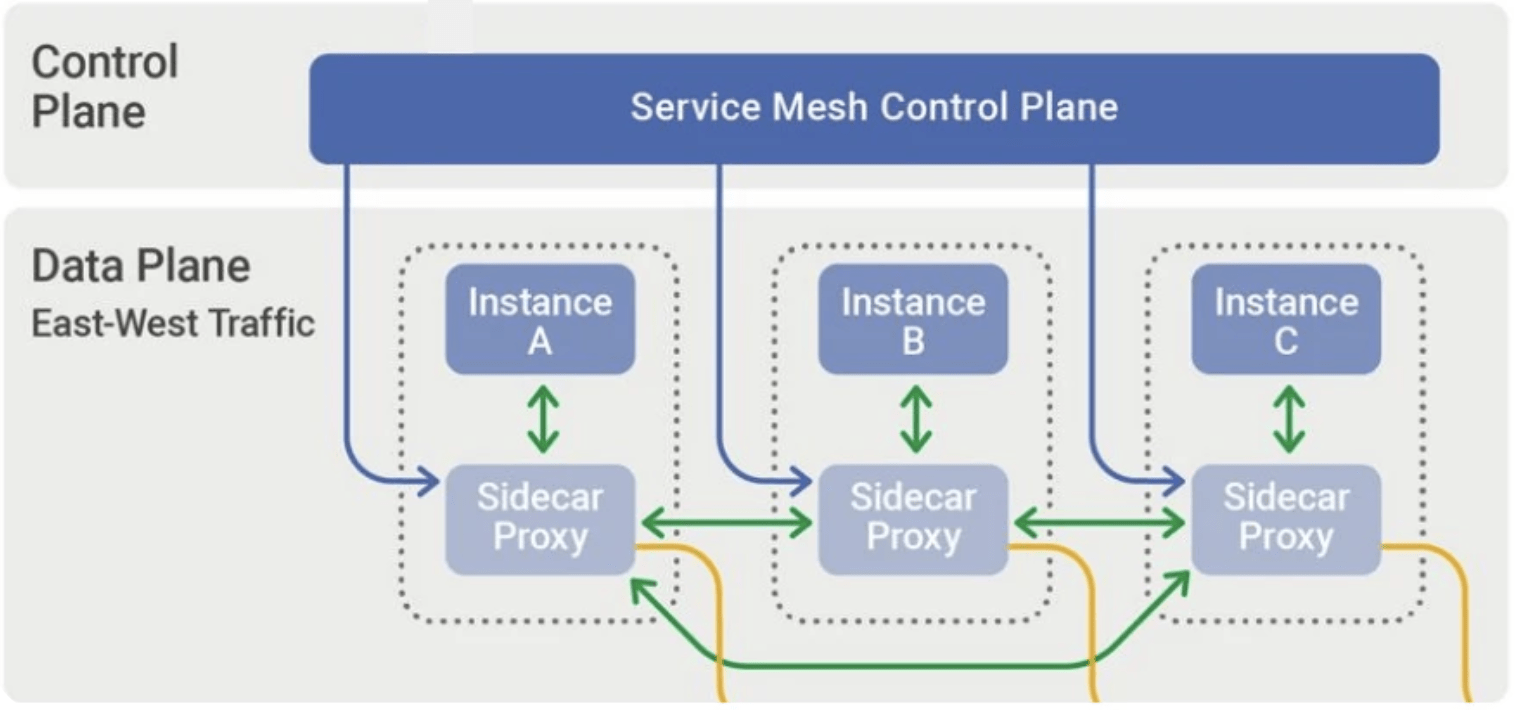
Service meshes are built using a distributed proxy model, commonly the sidecar proxy approach, where an instance of a proxy (like Envoy) is deployed alongside each service instance. All communication between services is routed through these proxies, which are configured and coordinated by a control plane responsible for managing policy, updates, and telemetry collection. This decentralized design optimizes intra-application communication but adds operational overhead.
Learn more in our detailed guide to service mesh architecture
4. Operational Complexity
API gateways are typically easier to operate than service meshes. They are deployed as centralized or distributed reverse proxies at the edge of the network. This model simplifies deployment and management, with fewer moving parts and lower resource consumption. Operational concerns mainly focus on scaling the gateway, managing plugins or extensions, and ensuring high availability. Since they only handle external traffic, their scope and configuration footprint remain relatively contained.
Service meshes introduce more complexity due to their decentralized architecture. Most service meshes use a sidecar pattern, injecting a proxy alongside every service instance. This increases deployment density, consumes more resources, and requires careful lifecycle management for each proxy. Some service meshes support daemonset-style deployments, where a single proxy per node handles traffic. This reduces overhead but loses the per-service granularity and isolation that sidecars provide.
5. Protocol and Scope Support
API gateways are generally optimized for HTTP and RESTful APIs, although many modern gateways now support gRPC, WebSockets, and other protocols. Their primary concern is handling externally facing APIs, and their protocol translation and mediation capabilities ensure that clients can connect to backend services regardless of client or service implementation details.
Service meshes support a broader range of protocols for internal communication, including HTTP, HTTP/2, gRPC, and sometimes raw TCP. Their scope extends to all internal services, and they offer features like mutual TLS (mTLS) and traffic shadowing across microservice protocols. The design focus is on the needs of internal system communication rather than servicing external clients.
6. Observability and Security
API gateways provide observability features, such as logging, tracing, metrics, and alerting focused on incoming requests and their handling by backend services. Security features include authentication, authorization, throttling, and policies for public-facing endpoints, making the gateway responsible for securing ingress points into the system.
Service meshes offer more observability for internal communications, tracking service-to-service metrics like latency, error rates, and traffic patterns in detail. Security features are typically deeper, providing mutual authentication between services, encryption of all internal communication, and fine-grained access controls at the service level. This ensures both observability and zero-trust security for east-west traffic across the entire microservices mesh.
Tips from the Expert
In my experience, here are tips that can help you effectively architect and operate environments where API gateways and service meshes coexist:
Run API gateways outside the mesh control plane for tighter blast radius control:
Deploy the gateway (e.g., Kong, Ambassador, Envoy) outside the service mesh control plane (separate namespace and trust domain). This isolates failures in external traffic management from internal mesh routing and avoids overloading Istiod with client traffic churn.
Use gateway-to-mesh mTLS bridging with trust anchors:
Terminate client TLS at the gateway, then re-establish internal mTLS when handing traffic into the mesh. Use SPIFFE federation or intermediate CA signing to create a trust bridge between the gateway and service mesh without violating zero-trust principles.
Reserve domain space for internal-only services with DNS split-horizon routing:
Define .svc.cluster.local or .internal domains for east-west services to prevent accidental exposure via the gateway. Split DNS ensures that external clients cannot resolve internal services, even if they’re misconfigured in the mesh.
Use service mesh telemetry to tune gateway rate limiting and caching:
Feed service mesh observability data (latency, error rates) back to the API gateway to dynamically adjust caching TTLs or rate limits. This creates an adaptive edge that responds to internal service health in real time.
Avoid duplicating auth logic—delegate authZ to mesh where possible:
Authenticate at the gateway (e.g., with OAuth or API key) and forward a signed JWT to internal services. Let the mesh enforce authorization via AuthorizationPolicy, removing the need to repeat logic in each service.

Service Mesh Pros and Cons
Service meshes offer capabilities for managing internal microservices communication, but they also come with notable trade-offs. Below are the key advantages and disadvantages to consider.
Pros:
- Fine-grained traffic control: Enables precise routing, fault injection, retries, and timeouts between services without modifying application code.
- Built-in security: Supports mutual TLS for encrypted service-to-service communication and service-level access policies.
- Observability: Provides detailed telemetry including latency, success rates, and request tracing across all service interactions.
- Resilience: Improves fault tolerance through features like circuit breakers and automatic failover.
- Consistency: Centralizes policy enforcement and configuration, reducing configuration drift across services.
Cons:
- Operational overhead: Requires maintaining a control plane and deploying sidecar proxies with each service, increasing complexity.
- Resource consumption: Sidecars consume CPU and memory for every service instance, potentially increasing infrastructure costs.
- Steep learning curve: Teams must understand service mesh concepts, configuration, and debugging procedures.
- Complex upgrades: Updating proxies and control planes across multiple services can be challenging and error-prone.
Related content: Read our guide to service mesh solutions
Related content: Read our guide on Service Mesh with eBPF: 5 Key Capabilities to learn how eBPF streamlines security and traffic management.
API Gateway Pros and Cons
API gateways are essential for managing and securing client-facing APIs, but they also introduce certain limitations. Below are the core pros and cons.
Pros:
- Centralized access control: Manages authentication, rate limiting, and security for all external traffic in one place.
- Protocol mediation: Translates between client-friendly protocols (e.g., HTTP, REST) and internal service protocols (e.g., gRPC).
- Request aggregation: Combines responses from multiple services into a single API call, simplifying client-side logic.
- Performance enhancements: Provides caching and throttling to reduce load on backend services.
- Monitoring and analytics: Offers visibility into API usage patterns and performance at the edge.
Cons:
- Single point of failure: If not properly scaled or replicated, the gateway can become a bottleneck or failure point.
- Limited internal visibility: Does not provide insight into internal service-to-service communication.
- Latency overhead: Adds processing time due to request inspection, routing, and transformation.
- Complex configuration: Managing plugins, routes, security policies, and versioning requires careful coordination.
API Gateway vs. Service Mesh: When to Use Which, and When to Use Both
Use Cases for an API Gateway
Use an API gateway when exposing services to external consumers, such as third-party developers, web applications, or mobile apps, who need a consistent, secure interface. It’s especially valuable when different clients require protocol mediation (e.g., converting REST to gRPC), request aggregation, or response shaping.
Gateways help enforce security policies, such as authentication and rate limiting, at the edge, reducing the attack surface and simplifying API lifecycle management. Typical scenarios include public-facing APIs, backend-for-frontend patterns, and B2B integrations where versioning, analytics, and access control must be centralized. API gateways also support DevOps workflows by decoupling external interfaces from internal service structures.
Use Cases for a Service Mesh
Use a service mesh when you need secure, reliable communication between microservices in a distributed system. It’s a fit for scenarios where fine-grained traffic control, observability, and zero-trust security are required at scale. For example, in systems with frequent service calls, interdependencies, or fault tolerance requirements, a mesh helps enforce consistent policies without adding logic to service code.
Common situations include multi-language microservices, systems with strict compliance needs (e.g., requiring mTLS), and complex deployment topologies like multi-cluster or multi-region environments. A service mesh also supports progressive delivery techniques like canary releases and traffic mirroring, making it useful for continuous deployment and testing strategies.
When to Use Both
Use both an API gateway and a service mesh when your architecture serves both external consumers and internal microservices. The gateway acts as the control point for ingress traffic, handling client authentication, rate limiting, and API transformations. The mesh handles internal communication, enforcing service-level policies, encrypting traffic, and providing deep observability.
This combination is useful for organizations running production-grade Kubernetes or service-based architectures at scale. For example, a gateway might receive a client request, authenticate it, and route it to a backend service. From there, the service mesh ensures secure, reliable communication across downstream services. Used together, they enable separation of concerns: the gateway handles external concerns, while the mesh governs internal behavior.
Key Considerations When Choosing a Solution
When deciding between an API gateway, a service mesh, or both, it’s important to evaluate your system’s specific needs and operational constraints. Below are key factors to consider:
- Operational complexity: Service meshes typically require more operational overhead than API gateways. Sidecar-based meshes inject a proxy alongside each service instance, increasing resource usage and deployment complexity. Some meshes support daemonset-style proxies to reduce overhead, but at the cost of per-service granularity. API gateways, by contrast, are deployed centrally and are generally simpler to manage.
- Traffic patterns: Consider whether your application primarily handles north-south traffic (client to server) or east-west traffic (service to service). If your focus is on controlling and monitoring external traffic, an API gateway is usually sufficient. If internal service-to-service communication needs encryption, routing control, and observability, a service mesh is the more appropriate choice.
- Protocol coverage: API gateways often focus on layer 7 (application layer) protocols like HTTP, gRPC, and WebSockets, with features like request transformation and aggregation. Service meshes typically operate across layers 4–7, supporting protocols like HTTP, HTTP/2, gRPC, and TCP for internal communication. Evaluate what protocols your services use and whether your chosen tool can handle them effectively.
- Observability and security needs: If your observability requirements are centered on external API usage, latency, and access logs, an API gateway provides sufficient metrics. For detailed internal telemetry, such as request tracing, error rates between services, and service-level latency, a service mesh offers more visibility. In terms of security, gateways manage client authentication and API keys, while meshes enforce mTLS, service-level access control, and policy-based authorization.
- Multi-cluster or hybrid-cloud requirements: In multi-cluster or hybrid-cloud environments, service meshes typically offer more built-in support for federated identity, cross-cluster communication, and consistent policy enforcement. However, this comes with added complexity in managing control planes, trust domains, and network overlays. API gateways can route between clusters or clouds using DNS or global load balancing, but may require custom integration.
- Integration and tooling flexibility: Evaluate how well the solution integrates with your existing CI/CD pipelines, observability stacks, and security tooling. API gateways often offer plugin ecosystems or built-in support for popular developer tools. Service meshes may require coordination with Kubernetes CRDs, custom controllers, or service discovery systems. Some platforms offer combined gateway-mesh solutions, which simplify integration but may reduce flexibility or increase vendor lock-in.
Choosing the right architecture depends on these trade-offs. Many teams adopt both tools to isolate external traffic handling from internal service concerns, but doing so requires clear boundaries and coordination between components.
How Tigera Simplifies Service Mesh and API Gateway Management
Modern microservices architectures require managing both external client-to-service traffic (north-south) and internal service-to-service communication (east-west). Historically, platform teams assembled this from separate projects — a CNI here, a gateway there, a service mesh on top — and paid an integration tax in sidecar overhead, version skew, and fragmented policy.
Tigera removes that burden by consolidating the CNI, ingress gateway, and service mesh into a single, operator-managed stack. The result is one platform that enforces policy from Layer 3 to Layer 7.
A Unified Approach to North-South and East-West Traffic
- Gateway API-native ingress: Calico Ingress Gateway is a 100% upstream Envoy Gateway distribution, giving teams a standardized, vendor-neutral way to manage external access, header-based routing, retries, rate limiting, and traffic splitting at the edge — with a web application firewall in front of workloads.
- Sidecarless service mesh: Calico includes an enterprise-hardened, 100% upstream distribution of Istio Ambient Mode. Instead of injecting a proxy into every pod, a per-node ztunnel handles L4 identity and encryption, while per-namespace waypoint proxies handle L7 routing, resilience, and identity-aware authorization. The Tigera Operator provisions, configures, and manages the lifecycle of both — so enrolling workloads is a namespace label, not a fleet of proxies to maintain.
- Operational simplicity with Calico AI: Calico AI lets platform teams interrogate complex network data and configurations in natural language — troubleshooting connectivity, generating policy, and surfacing insight without hours of manual log analysis.
Key Advantages
- mTLS by default: Encryption in transit and workload identity for all service-to-service communication, with no application code changes and no per-pod sidecars to inject, restart, or upgrade.
- Policy compatibility, not policy rewrites: Calico’s enhanced ztunnel preserves the original destination port, so your existing Calico and Kubernetes network policies keep enforcing exactly as written — no exception needed for port 15008, no loss of enforcement accuracy — alongside Istio’s L7 controls.
- Unified L3–L7 observability: OpenTelemetry data from the mesh joins Calico’s existing flow visibility in a single management plane, so latency, network errors, and L7 policy violations are all troubleshot in one place.
With a pluggable data plane architecture spanning standard Linux, eBPF, and nftables, the Calico platform gives teams one place to enforce policy across ingress, egress, pod-to-pod, service-to-service, and multi-cluster traffic — no integration tax, no vendor lock-in.
Next Steps
- 🚀 Deep Dive into Ambient Mode: Read An In-Depth Look at Istio Ambient Mode with Calico to see how we’ve eliminated the “sidecar tax.”
- 🚀 Explore the details: Read A Detailed Look at the Calico Ingress Gateway to see how it streamlines traffic security and control.
- 🛠️ Build it now: Use our step-by-step guide to deploy your first Calico Ingress Gateway and simplify your north–south traffic today.