





What Are AI Agent Security Platforms?
AI agent security platforms are specialized solutions that secure autonomous AI agents operating within enterprise environments. These platforms focus on managing the risks posed by AI agents, which interact with sensitive data, automate decisions, and often operate at scale.
Unlike traditional security tools, AI agent security platforms address the dynamic, self-directed, and interconnected nature of AI agents, requiring visibility, control, and real-time response mechanisms. These platforms provide capabilities such as agent discovery, identity management, policy enforcement, runtime protection, and automated remediation.
Their goal is to prevent unauthorized actions, data leakage, and manipulation of AI agent behavior. By integrating with cloud-native infrastructures, they help organizations maintain compliance, enforce governance, and support the trustworthy operation of AI-driven automation in complex environments.
This is part of a series of articles about AI agent security.
In this article:
- Why Cloud-Native Deployments Need Specialized AI Agent Security
- Key Capabilities of AI Agent Security Platforms
- Notable AI Agent Security Platforms for Cloud-Native Deployments
Why Cloud-Native Deployments Need Specialized AI Agent Security
Cloud-native environments introduce patterns and risks that traditional security models do not handle well. AI agents amplify these challenges by acting autonomously across distributed systems. This section outlines the key reasons specialized security controls are required:
- Ephemeral and dynamic infrastructure: Containers, serverless functions, and short-lived workloads make it hard to track agent activity. Security tools must discover and monitor agents in real time, even as environments constantly change.
- High degree of automation: AI agents execute tasks without human approval. This increases the risk of rapid, large-scale impact if an agent is misconfigured or compromised.
- Complex identity and access flows: Agents often use multiple identities, tokens, and APIs. Managing least-privilege access becomes harder, especially when agents interact across services and accounts.
- East-west traffic and service sprawl: Cloud-native systems rely on service-to-service communication. Agents move laterally across services, making it difficult to enforce boundaries with traditional perimeter security.
- Integration with sensitive data pipelines: AI agents frequently access training data, logs, and user inputs. Without strict controls, this can lead to data leakage or unintended exposure of sensitive information.
- Real-time decision making: Agents make decisions during execution, not just at deployment time. Security must monitor runtime behavior and stop unsafe actions as they happen.
- Third-party and API dependencies: Agents rely heavily on external APIs and tools. Each dependency introduces new attack surfaces, including supply chain risks and malicious responses.
- Scaling risks with workload growth: As organizations scale AI usage, the number of agents increases rapidly. Security systems must handle large volumes of agent activity without losing visibility or control.
- Policy enforcement across distributed systems: Enforcing consistent security policies is difficult when agents operate across multiple clusters, regions, and cloud providers.
- Limited observability with traditional tools: Standard logging and monitoring tools are not built to capture agent intent, reasoning steps, or decision paths. Specialized platforms provide deeper insight into agent behavior.
Related content: Read our guide to agentic AI security
Key Capabilities of AI Agent Security Platforms
1. Agent Discovery and Inventory
Agent discovery and inventory are foundational capabilities for AI agent security platforms. These functions enable organizations to automatically detect and catalog all AI agents operating within their environments, regardless of deployment model or cloud provider. Discovery tools identify both sanctioned and unsanctioned agents, providing an inventory that forms the basis for risk management and policy enforcement.
Maintaining an up-to-date inventory is crucial in fast-changing cloud-native settings, where agents may be spun up or deprecated frequently. By continuously monitoring for new or modified agents, security teams can identify unauthorized deployments or misconfigurations.
2. Identity and Access Control
Identity and access control are critical for managing the permissions and interactions of AI agents. Security platforms implement authentication, authorization, and role-based access controls to ensure that agents only access data and resources necessary for their assigned tasks. These mechanisms restrict lateral movement and limit the impact of compromised agents.
Granular access policies can be enforced at the agent, application, or service level. This prevents privilege escalation and supports the principle of least privilege, reducing the attack surface. Identity and access control also enable integration with existing identity providers and support compliance with regulatory requirements for data access and usage.
3. Runtime Protection
Runtime protection focuses on monitoring and defending AI agents during operation. Security platforms provide real-time analysis of agent behavior, detecting anomalies that may indicate compromise, misuse, or deviation from expected activity. This includes monitoring for unauthorized data access, command execution, or attempts to subvert agent logic.
Runtime protection allows organizations to block malicious actions and contain threats before they escalate. By integrating with runtime environments, these platforms can enforce security policies dynamically, ensuring that AI agents remain within defined operational boundaries.
4. Policy Enforcement and Governance
Policy enforcement and governance ensure that AI agents operate according to organizational standards and regulatory requirements. Security platforms provide centralized policy management, allowing administrators to define and enforce rules governing agent behavior, data usage, and interaction with other systems. Automated policy enforcement reduces the risk of human error and maintains consistent security postures across dynamic environments.
Governance features also include audit trails, reporting, and support for compliance frameworks. These capabilities help organizations demonstrate adherence to internal and external mandates and support incident investigation and accountability. Policy enforcement and governance help reduce risk and maintain control over autonomous AI agent ecosystems.
Related content: Learn more in our guide to AI agent governance
5. Observability and Monitoring
Observability and monitoring provide visibility into AI agent activity, system interactions, and potential security incidents. Security platforms collect telemetry from agents, applications, and infrastructure, correlating data to identify patterns and anomalies. This monitoring helps security teams detect threats, performance issues, and compliance violations in real time.
Observability tools include dashboards, alerts, and customizable reporting, enabling rapid response and informed decision-making. By maintaining logs and contextual information, organizations can investigate incidents and refine their security strategies over time.
6. Automated Response and Remediation
Automated response and remediation capabilities enable rapid containment and resolution of security incidents involving AI agents. Security platforms use predefined rules, playbooks, and machine learning models to identify threats and trigger automated actions, such as isolating compromised agents, revoking credentials, or rolling back unauthorized changes.
By automating incident response, organizations can reduce dwell time and limit the impact of attacks. Remediation workflows can be customized to align with business requirements and compliance obligations, ensuring that corrective actions are effective and auditable.
Tips from the Expert
In my experience, here are tips that can help you better secure AI agent platforms in cloud-native deployments:
Create an agent action ledger, not just logs:
Record every agent decision as a structured event: user intent, agent identity, tool invoked, resource touched, data class, policy result, and final action. This gives responders a replayable “why did it act?” trail rather than disconnected prompts and API logs.
Use task-scoped credentials instead of agent-scoped credentials:
Do not give an agent a reusable cloud role just because it is a trusted agent. Mint short-lived credentials per task, with the allowed tool, resource, time window, and business purpose embedded in the authorization flow.
Put agents behind egress choke points:
Route outbound agent traffic through controlled egress gateways by agent class, such as support agents, DevOps agents, and data-analysis agents. This makes unusual API destinations, DNS behavior, and exfiltration attempts easier to detect and block.
Deploy canary tools and fake high-value resources:
Create decoy MCP servers, fake credentials, synthetic datasets, and “admin-only” tools that no legitimate agent workflow should touch. Any access is a high-signal indicator of prompt injection, tool misuse, or lateral movement.
Gate irreversible actions by blast radius, not confidence score:
Agents can sound confident while being wrong. Require human approval or staged execution for actions that delete data, rotate production secrets, change IAM, modify firewall policy, trigger payments, or affect customer-facing systems.

Notable AI Agent Security Platforms for Cloud-Native Deployments
1. Tigera Lynx

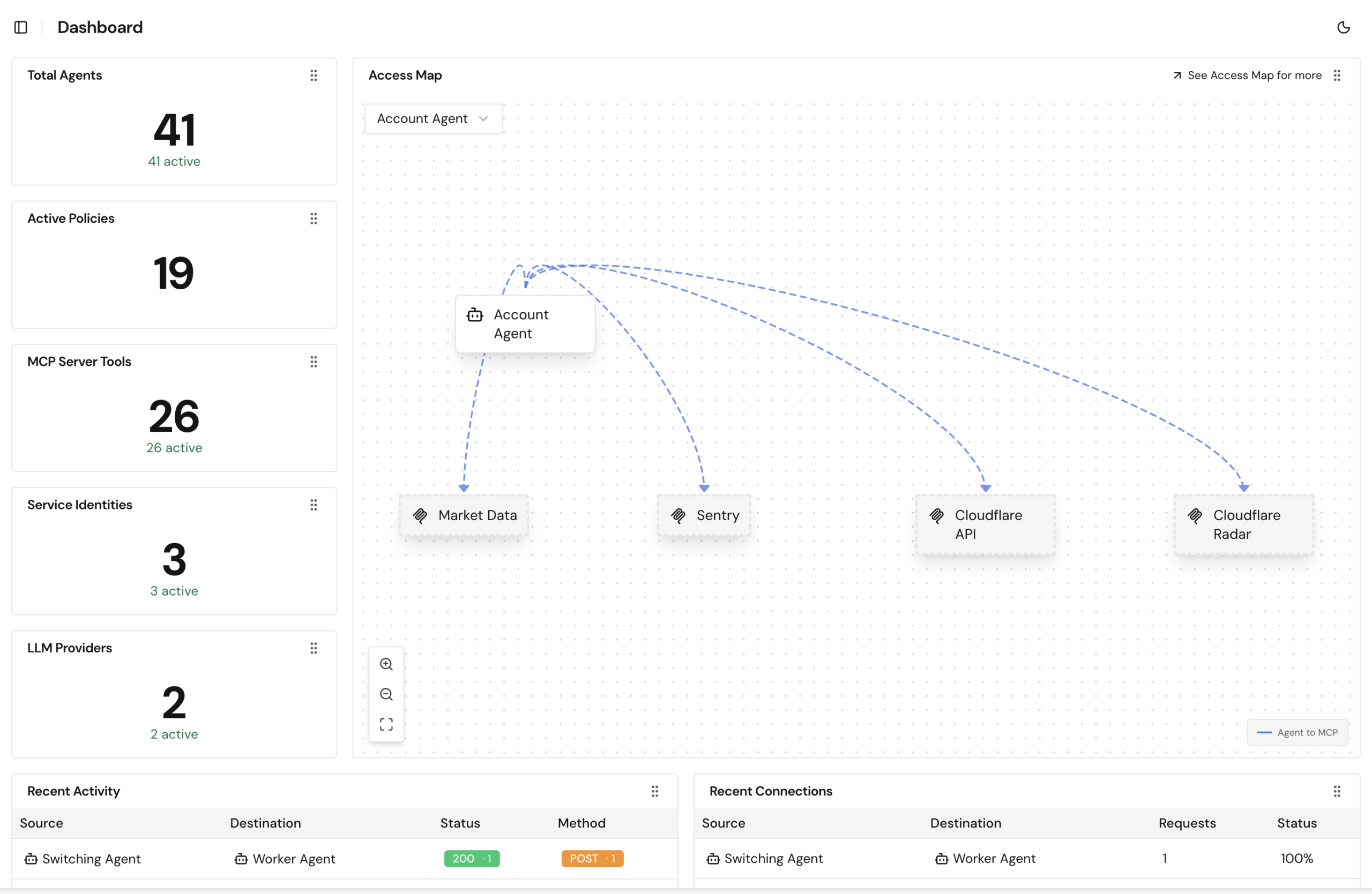
Tigera provides Lynx, a unified control plane for Kubernetes-native AI agents. Lynx sits in the path of every agent call (agent-to-agent, agent-to-tool, and agent-to-LLM) to authenticate, authorize, mediate, and audit each one. It gives enterprises a single place to find every agent in their Kubernetes estate, tighten posture, assign a sandbox, give each agent cryptographic identity, enforce policy on every action it takes, audit what agents actually do and detect anomalous behavior. Lynx plugs into the tools enterprises already run, including their identity provider (EntraID, Okta) or via SPIFFE/SPIRE, and existing observability systems, and is built on open standards rather than proprietary lock-in.
Key features include:
- Discovery, registration, and observability: A central registry catalogs every agent with its owner, purpose, and version, while eBPF-powered auto-discovery finds agents nobody registered. Shadow agents are flagged and quarantined, and any agent’s actions can be reconstructed end-to-end through OpenTelemetry traces.
- Configuration and posture management: AI-CSPM continuously evaluates every agent against a baseline, surfacing drift and over-permissions the moment they happen, with per-agent sandboxing and pre-built compliance packs mapping to GDPR, HIPAA, SOC 2, and financial services requirements. A Red Team Agent continuously probes for weaknesses in posture and misconfigurations.
- Identity and authentication: Every agent gets a verifiable cryptographic identity through integration into an enterprise’s identity provider (EntraID, Okta) or through SPIFFE/SPIRE, with no shared secrets. Long-lived API keys are replaced by short-lived and tightly scoped, auto-rotated tokens. A JWT token is minted for every hop in a multi-agent workflow.
- Policy definition and enforcement: A single default-deny policy governs LLM, MCP, and agent access using the Cedar policy language, enforced at the gateway before any call executes — with no agent code changes. Misbehaving agents can be quarantined instantly and high-stakes calls routed to a human.
- Anomalous behavior detection: eBPF and LSM watch every syscall, network call, and file access at a layer agents can’t tamper with, catching credential theft and lateral movement even when an action passes policy. This provides a forensic audit trail. Guardian Agent detects anomalous behavior and quarantines suspicious agents.
Source: Tigera
2. Prisma AIRS

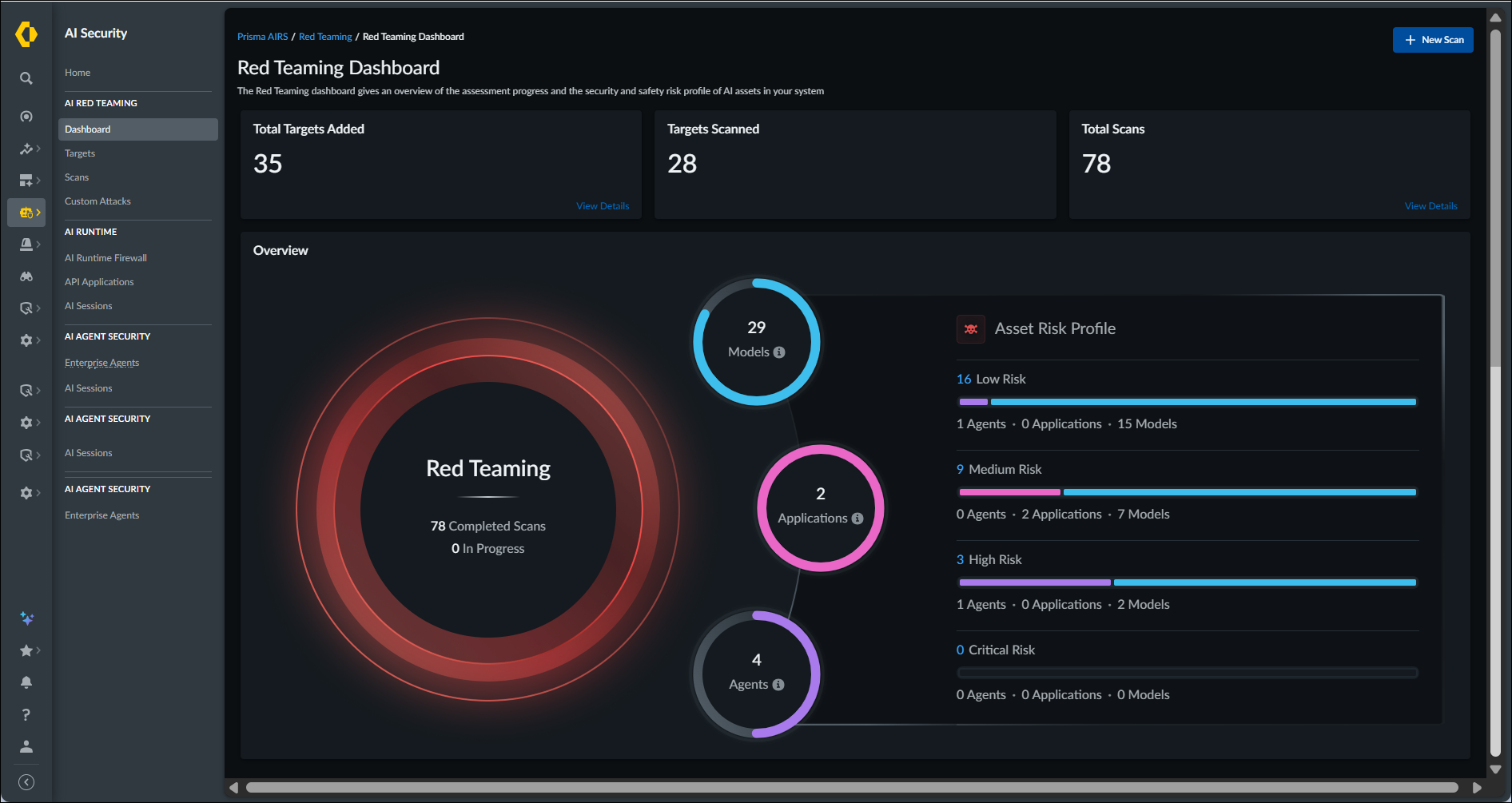
Prisma AIRS is a unified AI security platform that helps secure AI agents from development to deployment and runtime. It provides centralized visibility and control over agents, models, and data, allowing organizations to manage risk as AI systems scale. The platform focuses on preventing unauthorized actions, reducing exposure of sensitive data, and identifying weaknesses early through testing and scanning.
General features include:
- AI lifecycle security: Covers development, testing, deployment, and runtime.
- Unified control plane: Consolidates security capabilities into a single platform.
- AI red teaming and attack simulation: Uses predefined and dynamic attack scenarios to test agent behavior under real-world conditions.
- AI model security scanning: Analyzes third-party and internal models for vulnerabilities such as embedded malicious code, unsafe serialization patterns, and signs of tampering.
- AI posture management: Provides insight into the state of AI assets, including training data, model integrity, and agent configurations.
Cloud deployment features:
- Automated agent discovery across environments: Identifies AI agents running in SaaS platforms, cloud services, low-code tools, and custom deployments, including unmanaged agents.
- Centralized visibility into distributed systems: Provides a single view of agent activity, including actions, data access, and decision paths across cloud environments.
- Real-time runtime protection: Monitors live agent interactions and enforces safeguards to block prompt injection, malicious tool usage, and unsafe outputs.
- Agent identity verification and management: Maintains an inventory of agent identities, validates ownership, and enforces least-privilege access across cloud systems.
- Granular control of AI interactions: Governs LLM calls, tool usage, and model context protocol (MCP) connections with fine-grained policies.
Source: Prisma Airs
3. WitnessAI
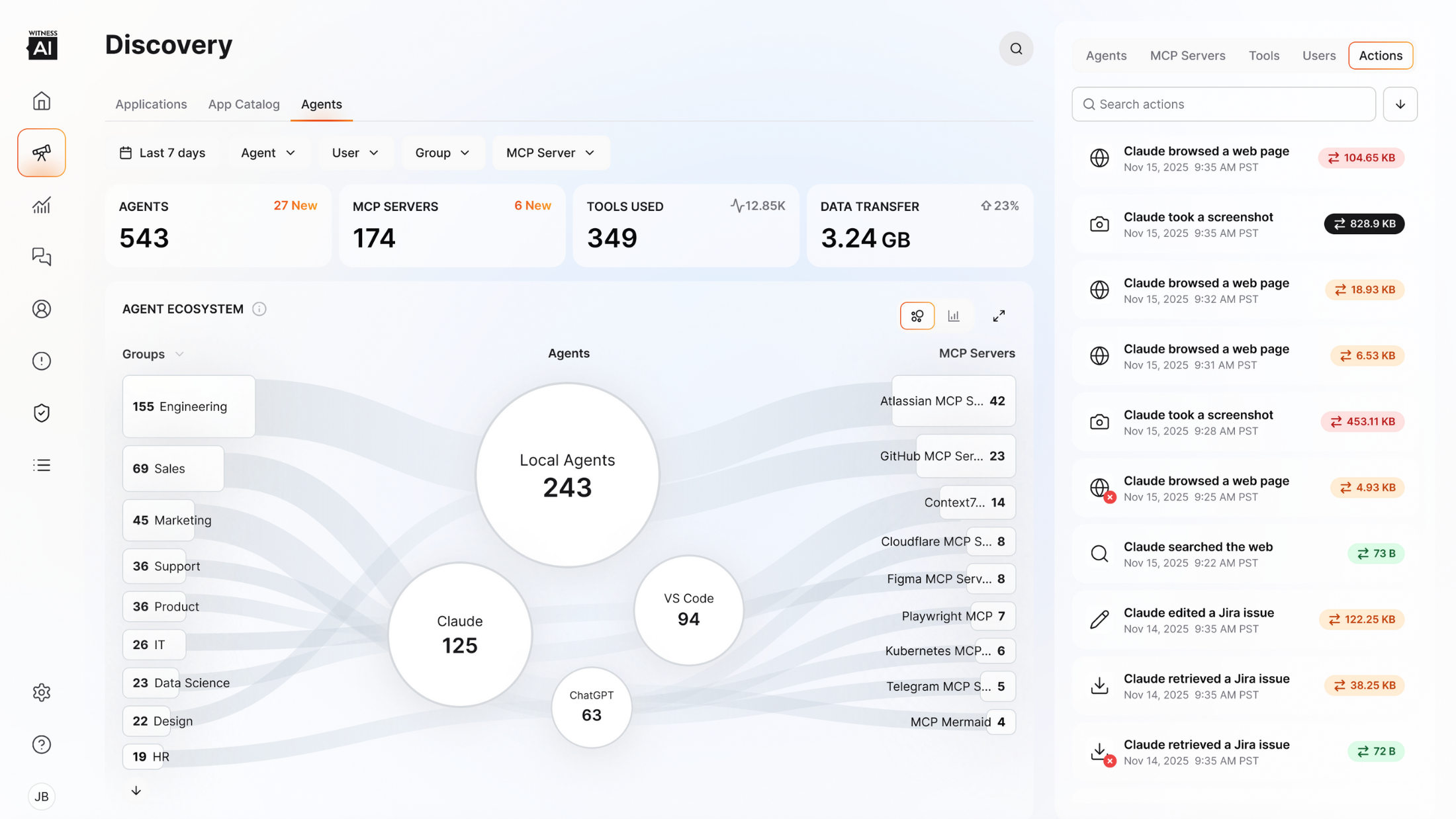
WitnessAI is an AI security and governance platform that provides visibility, protection, and control over human and AI-driven interactions with enterprise AI systems. It monitors AI activity across applications, agents, and models, while enforcing behavior-based security policies at runtime.
General features include:
- AI activity visibility: Discovers and catalogs AI applications, agents, and MCP servers across the organization.
- Real-time interaction monitoring: Captures and visualizes prompts and responses across users and agents.
- Intent-based classification: Analyzes interactions based on context and intent rather than keyword matching.
- Shadow AI detection: Identifies unsanctioned or unmanaged AI tools and agents.
- AI firewall and threat prevention: Blocks attacks before they reach models or agents, including jailbreak attempts and prompt injection attacks.
Cloud deployment features:
- Network-level visibility across distributed environments: Monitors AI traffic and interactions across cloud applications, agents, and services.
- Unified governance for human and AI agents: Applies consistent policies across employee-driven and autonomous agent interactions in cloud systems.
- Runtime security for AI agents and applications: Enforces behavior-based controls during execution to govern agent actions.
- Dynamic policy enforcement based on context: Adjusts controls in real time depending on user role, intent, or risk level.
- Centralized control of AI interactions: Routes prompts to appropriate models based on cost, risk, or purpose.
Source: WitnessAI
4. CyberArk

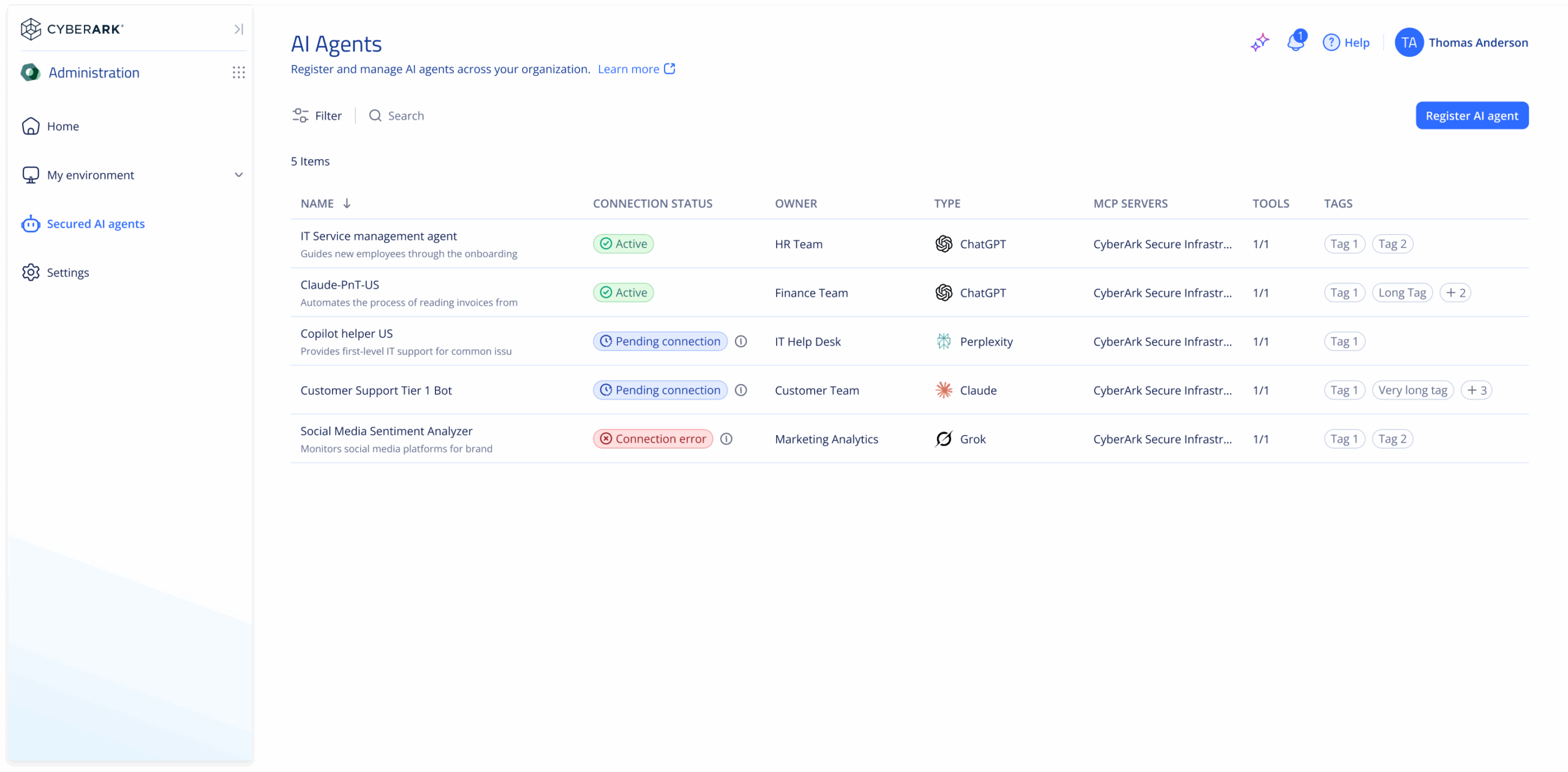
CyberArk Secure AI Agents is an identity security solution focused on controlling and managing the privileges of AI agents across enterprise environments. It treats agents as privileged identities and applies strict access controls to ensure they only interact with sensitive resources when necessary.
General features include:
- Agent discovery with contextual enrichment: Identifies AI agents across SaaS, cloud, and development environments and enriches them with metadata such as ownership, purpose, status, and permissions.
- Identity-first security model: Treats each AI agent as a privileged identity, applying authentication and authorization controls to manage access to sensitive systems.
- Privilege management: Assigns permissions based on specific tasks.
- Zero standing privileges approach: Grants privileges temporarily and revokes them automatically after task completion.
- Centralized visibility into agent actions: Tracks actions agents perform and resources they access.
Cloud deployment features:
- Cross-environment agent discovery: Detects agents running across cloud platforms, SaaS applications, and developer tools.
- Agent gateway for access enforcement: Acts as a control point between AI agents and cloud resources, enforcing permissions on every interaction.
- Just-in-time access in cloud workflows: Grants temporary, task-specific access to cloud services and revokes it automatically.
- Centralized control over cloud resource access: Manages how agents interact with infrastructure, APIs, and tools without exposing long-lived credentials.
- Monitoring of cloud-based agent activity: Tracks actions, tool calls, and system interactions across distributed environments.
Source: CyberArk
5. Okta Secures AI
Okta Secures AI is an identity-centric platform that governs and secures AI agents across their lifecycle using a unified control plane. It focuses on visibility, accountability, and access control for human and nonhuman identities interacting with AI systems. By addressing where agents exist, what they can access, and what actions they can take, the platform helps organizations eliminate shadow AI, enforce governance, and scale agentic systems.
General features include:
- Unified identity platform for AI agents: Centralizes management of human and AI identities.
- Full lifecycle management: Supports agent governance from creation and deployment to operation and retirement.
- Shadow AI detection: Identifies unmanaged or unknown agents operating in the environment.
- Agent ownership assignment: Links every agent to a responsible owner.
- Identity context propagation: Ensures agents operate with verified user context.
Cloud deployment features:
- Single control plane across cloud environments: Governs agents deployed across cloud, SaaS, and hybrid systems from one platform.
- Automated discovery of agents in cloud stacks: Finds agents running across infrastructure and applications.
- Scalable identity and access management: Applies identity controls to large numbers of agents as cloud usage grows.
- Dynamic access enforcement: Adjusts agent permissions based on context, role, and usage patterns in real time.
- Secure agent-to-resource interactions: Controls what agents can do within cloud systems.

Source: Okta Secure AI
6. SailPoint Agent Identity Security

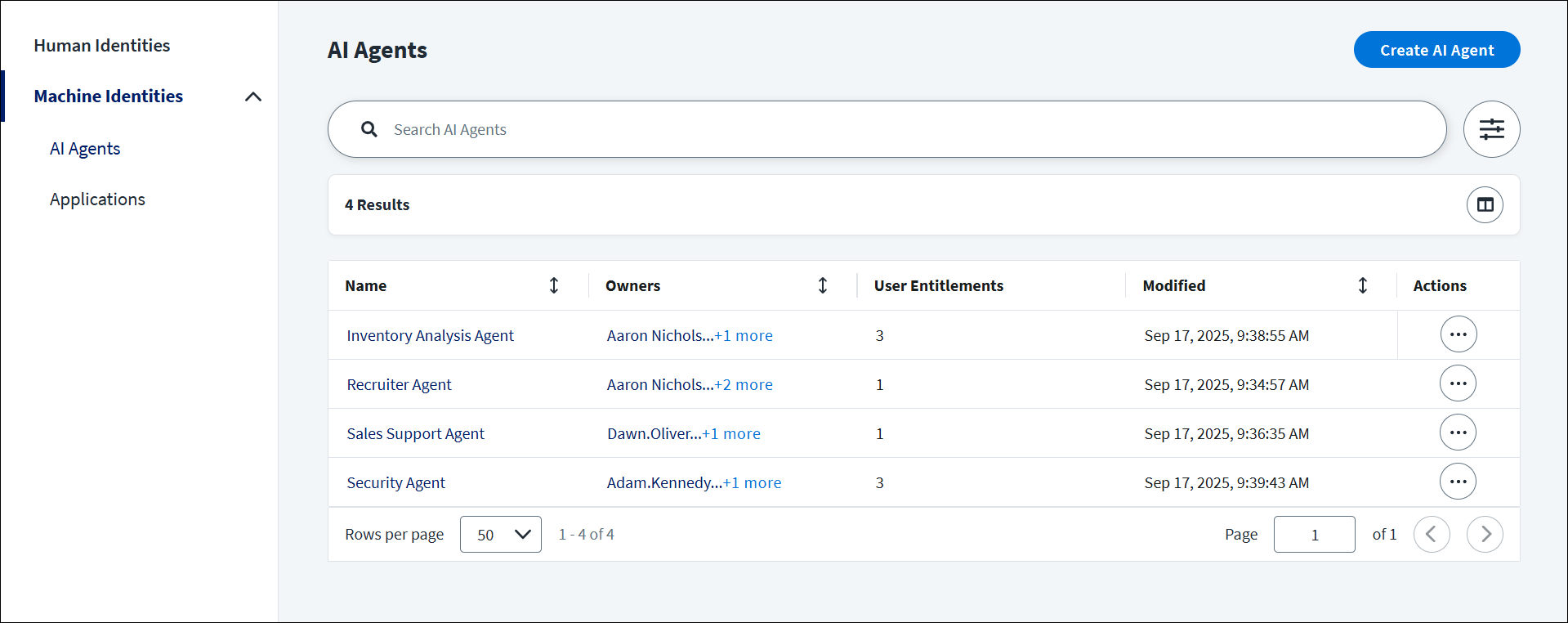
SailPoint Agent Identity Security is an identity governance solution that brings visibility, control, and accountability to AI agents across enterprise environments. It manages AI agents as identities, consolidating information about agents, their owners, and their access into a single governed view.
General features include:
- Unified view of AI agent identities: Aggregates agents, associated users, and accessed resources into a single governance layer.
- Centralized agent inventory across platforms: Connects to multiple environments to onboard and track AI agents with identity and access context.
- Shadow AI visibility and risk reduction: Detects unmonitored or unknown AI agents and provides controls to remediate risks.
- Ownership assignment and accountability: Assigns one or multiple human owners to each agent.
- Dynamic ownership management: Updates ownership automatically as roles change.
Cloud deployment features:
- Cross-cloud agent aggregation: Integrates with platforms such as AWS, Azure, Google Cloud Platform, and Salesforce to discover and onboard AI agents.
- Automated onboarding of cloud-based agents: Registers agents with unique identities and contextual metadata as they are discovered.
- Centralized governance across distributed systems: Applies identity and access policies across multicloud and SaaS deployments.
- Continuous access validation in dynamic environments: Reviews and adjusts permissions as cloud workloads and agent roles evolve.
- Visibility into cloud-based agent interactions: Provides insight into resources agents access and how they operate across cloud services.
Source: SailPoint
Conclusion
AI agent security platforms address gaps that traditional tools cannot cover, especially in cloud-native environments where agents operate autonomously and at scale. Their value comes from combining visibility, identity control, runtime protection, and automated response into a unified approach. To be effective, these platforms must handle dynamic infrastructure, enforce consistent policies, and provide real-time insight into agent behavior.