





What Are AI Agent Security Platforms?
Securing AI agents in Kubernetes involves managing ephemeral, high-risk workloads that act as digital workspaces with access to sensitive data. Top platforms for this purpose include Tigera Lynx (AI agent discovery, identity, authorization, and enforcement) and AppGate ZTNA (agentic AI workload protection).
Unlike traditional application security tools, these platforms address the complex, dynamic, and often unpredictable behaviors of AI agents, which can include large language models, autonomous bots, and task-oriented digital workers.
The platforms typically integrate with cloud-native environments and orchestrators like Kubernetes, providing real-time monitoring, behavioral analysis, and automated response to threats specifically targeting or originating from AI agents.
This is part of a series of articles about AI agent security.
In this article
- Why Kubernetes Needs AI Agent Security Platforms
- Core Security Risks in AI Agents on Kubernetes
- Key Features of AI Agent Security Platforms for Kubernetes
- Notable AI Agent Security Platforms and Frameworks for Kubernetes
Why Kubernetes Needs AI Agent Security Platforms
Growth of Agentic Workloads
The adoption of AI agents within Kubernetes environments is increasing as organizations automate processes, optimize operations, and deliver intelligent services. These agentic workloads are not limited to simple automation scripts; they often involve complex decision-making, dynamic tool orchestration, and continuous learning capabilities.
As a result, they increase the attack surface and introduce new vectors that traditional security controls were not built to manage. With more AI agents deployed, the risk of accidental or intentional misuse rises, requiring specialized security measures. Kubernetes enables rapid scaling and deployment of agentic workloads, which increases security challenges.
Unique Security Challenges
AI agents introduce security concerns that differ from those of traditional applications. Their autonomy, ability to interact with external APIs, and potential to learn or evolve over time create unpredictable behavior patterns. This unpredictability makes it difficult to apply static security policies, as agents may deviate from expected workflows based on context or new data.
Attackers can exploit these behaviors using prompt injection, tool misuse, or privilege escalation to subvert agent operations. AI agents often have elevated permissions to perform complex tasks, making them targets for attackers seeking lateral movement or data exfiltration. The interconnectivity between agents, tools, and backend systems increases the potential impact of a compromised agent.
Gaps in Traditional Kubernetes Security
Traditional Kubernetes security tools focus on container security, network segmentation, and policy enforcement at the infrastructure level. While effective for managing microservices and user-driven applications, these tools do not fully address the risks posed by AI agents.
Standard runtime protections may fail to detect abnormal agent behavior or unauthorized tool usage, as these actions can fall within an AI agent’s operational scope. As a result, agent-specific threats can go unnoticed or unmitigated. Kubernetes-native security solutions often lack visibility into the decision-making processes and external interactions of AI agents.
Related content: Read our guide to securing AI agents
Core Security Risks in AI Agents on Kubernetes
Identity and Access Risks
AI agents often require broad permissions to complete their tasks, which can create identity and access management risks. If an agent’s credentials are compromised or misconfigured, attackers can gain unauthorized access to sensitive resources, escalate privileges, or move laterally within the cluster.
Inadequate segregation of duties and insufficient credential rotation increase these risks, making identity a primary attack vector for agentic workloads. AI agents may also leak credentials or access tokens during tool integration or external API calls. Without strict monitoring and enforcement of least privilege principles, the risk of privilege abuse or credential sprawl increases.
Runtime and Execution Risks
The dynamic execution patterns of AI agents create runtime risks. Agents may execute untrusted code, load external plugins, or interact with third-party services at runtime, expanding the attack surface. Malicious actors can exploit these behaviors to inject harmful payloads, execute unauthorized commands, or disrupt agent operations.
Kubernetes’ flexible runtime environment can enable rapid spread of malicious activity if not secured properly. AI agents often make decisions in real time, adapting execution based on inputs or feedback. This adaptive behavior complicates static security measures, as agents may trigger unintended side effects.
Data Security Risks
AI agents often process sensitive data, including personally identifiable information, proprietary business logic, or confidential customer records. Weak data handling practices or insufficient access controls can lead to unauthorized exposure, leakage, or theft.
Attackers may target agents to exfiltrate sensitive information or manipulate data flows, taking advantage of weak encryption, unprotected storage, or unsecured data transfers within the Kubernetes environment. AI agents that interact with multiple data sources or external APIs face increased risk of data contamination or poisoning. Adversaries can inject malicious data to influence agent behavior, degrade model performance, or trigger unintended actions.
Network and Communication Risks
AI agents rely on network communication to interact with APIs, tools, and services, making network security a primary concern. Unrestricted network access can allow agents to connect to malicious endpoints, transmit sensitive data to unauthorized recipients, or participate in command-and-control operations.
Attackers may exploit open network policies to intercept, manipulate, or redirect agent communications, leading to data breaches or service disruption. The dynamic nature of agent interactions complicates traditional network segmentation and monitoring. Agents may initiate unpredictable outbound connections or respond to dynamic events, bypassing static firewall rules or intrusion detection systems.
Tips from the Expert
In my experience, here are tips that can help you better secure AI agent workloads on Kubernetes:
Treat every agent as a volatile security principal:
Don’t bind long-lived permissions to an agent deployment. Issue short-lived, task-scoped identities per run, per conversation, or per workflow step so a compromised agent cannot reuse yesterday’s authority.
Separate reasoning pods from tool-execution pods:
Run the LLM orchestration layer in one trust zone and high-risk tools, such as shell, browser, database, or code execution, in isolated executor pods with narrower policies. This makes prompt injection less likely to become cluster compromise.
Create egress tiers instead of one outbound policy:
Give agents different egress classes: no internet, approved SaaS only, approved APIs plus DNS, or break-glass internet. Most agent incidents start as “unexpected but technically allowed” outbound communication.
Baseline tool chains, not just individual calls:
An API call may look normal in isolation, but risky in sequence. Detect patterns such as “read sensitive table → summarize → call external webhook” or “clone repo → execute script → request cloud token.”
Use decoy tools and canary resources:
Expose fake secrets, fake internal APIs, or honeytoken tools to agents. A legitimate workflow should never call them, so access becomes a high-confidence signal of prompt injection, tool abuse, or autonomous drift.

Key Features of AI Agent Security Platforms for Kubernetes
AI-Powered Threat Detection Agents
AI-powered threat detection agents use machine learning models to identify suspicious activity and threats specific to agentic workloads. Unlike signature-based systems, these agents analyze behavioral patterns, communication flows, and contextual signals unique to AI agents.
These detection agents integrate with Kubernetes, monitoring agent activity at the application and infrastructure layers. They can flag unauthorized tool usage, abnormal API calls, or deviations from behavioral baselines in real time. Automated alerting and event enrichment help security teams respond to incidents and reduce exposure to agent-driven attacks.
Autonomous Incident Response
Autonomous incident response enables AI agent security platforms to react to detected threats without human intervention. Using predefined playbooks, policy as code, and automated remediation workflows, these platforms can isolate compromised agents, revoke credentials, or block malicious network traffic when suspicious activity is identified.
Autonomous response systems refine their actions based on feedback and incident outcomes. They can coordinate with orchestration tools to quarantine affected workloads, roll back risky changes, or trigger forensic analysis. Automated response is important in dynamic agentic environments where manual intervention may be too slow to contain threats.
Policy as Code for AI Behavior
Policy as code frameworks allow organizations to define and enforce rules governing AI agent behavior using code-based policies. These policies can specify permitted actions, tool access, data usage, and API call restrictions, enabling granular control over agent operations. By integrating with Kubernetes policy engines, security teams can enforce policies across large-scale agentic deployments and reduce human error.
Policy as code supports versioning, auditing, and automated testing, making it easier to update and validate security rules as agent workloads change. This approach allows teams to respond to new threats or compliance requirements while keeping AI agents within defined boundaries.
Behavioral Anomaly Detection
Behavioral anomaly detection identifies deviations from an agent’s normal operating patterns. Instead of relying on fixed rules, these systems establish baselines for how agents interact with tools, APIs, data, and services. When an agent exhibits unusual behavior, such as unexpected API sequences, abnormal data access, or sudden execution changes, the platform flags it for investigation or triggers mitigation.
These systems use statistical models and machine learning to refine what normal behavior looks like in a Kubernetes environment. They correlate signals across application logs, network traffic, and orchestration events. This detection helps identify subtle attacks like prompt injection or slow data exfiltration that can bypass traditional controls.
Secure Tool Usage and API Governance
Secure tool usage and API governance ensure that AI agents interact with external tools and services in a controlled and auditable manner. Platforms enforce allowlists that define which tools an agent can access and under what conditions. Each API call can be inspected in real time, with policies applied to limit parameters, rate, and data exposure.
Governance layers provide visibility into how agents chain tools together to complete tasks. Many attacks exploit multi-step workflows rather than single actions. By tracking and constraining these interactions, security platforms can prevent unauthorized operations and block risky tool combinations.
Notable AI Agent Security Platforms and Frameworks for Kubernetes
1. Tigera Lynx

Tigera provides Lynx, a unified control plane for Kubernetes-native AI agents. Lynx sits in the path of every agent call (agent-to-agent, agent-to-tool, and agent-to-LLM) to authenticate, authorize, mediate, and audit each one. It gives enterprises a single place to find every agent in their Kubernetes estate, tighten posture, assign a sandbox, give each agent cryptographic identity, enforce policy on every action it takes, audit what agents actually do and detect anomalous behavior. Lynx plugs into the tools enterprises already run, including their identity provider (EntraID, Okta) or via SPIFFE/SPIRE, and existing observability systems, and is built on open standards rather than proprietary lock-in.
Key features include:
- Discovery, registration, and observability: A central registry catalogs every agent with its owner, purpose, and version, while eBPF-powered auto-discovery finds agents nobody registered. Shadow agents are flagged and quarantined, and any agent’s actions can be reconstructed end-to-end through OpenTelemetry traces.
- Configuration and posture management: AI-CSPM continuously evaluates every agent against a baseline, surfacing drift and over-permissions the moment they happen, with per-agent sandboxing and pre-built compliance packs mapping to GDPR, HIPAA, SOC 2, and financial services requirements. A Red Team Agent continuously probes for weaknesses in posture and misconfigurations.
- Identity and authentication: Every agent gets a verifiable cryptographic identity through integration into an enterprise’s identity provider (EntraID, Okta) or through SPIFFE/SPIRE, with no shared secrets. Long-lived API keys are replaced by short-lived and tightly scoped, auto-rotated tokens. A JWT token is minted for every hop in a multi-agent workflow.
- Policy definition and enforcement: A single default-deny policy governs LLM, MCP, and agent access using the Cedar policy language, enforced at the gateway before any call executes — with no agent code changes. Misbehaving agents can be quarantined instantly and high-stakes calls routed to a human.
- Anomalous behavior detection: eBPF and LSM watch every syscall, network call, and file access at a layer agents can’t tamper with, catching credential theft and lateral movement even when an action passes policy. This provides a forensic audit trail. Guardian Agent detects anomalous behavior and quarantines suspicious agents.
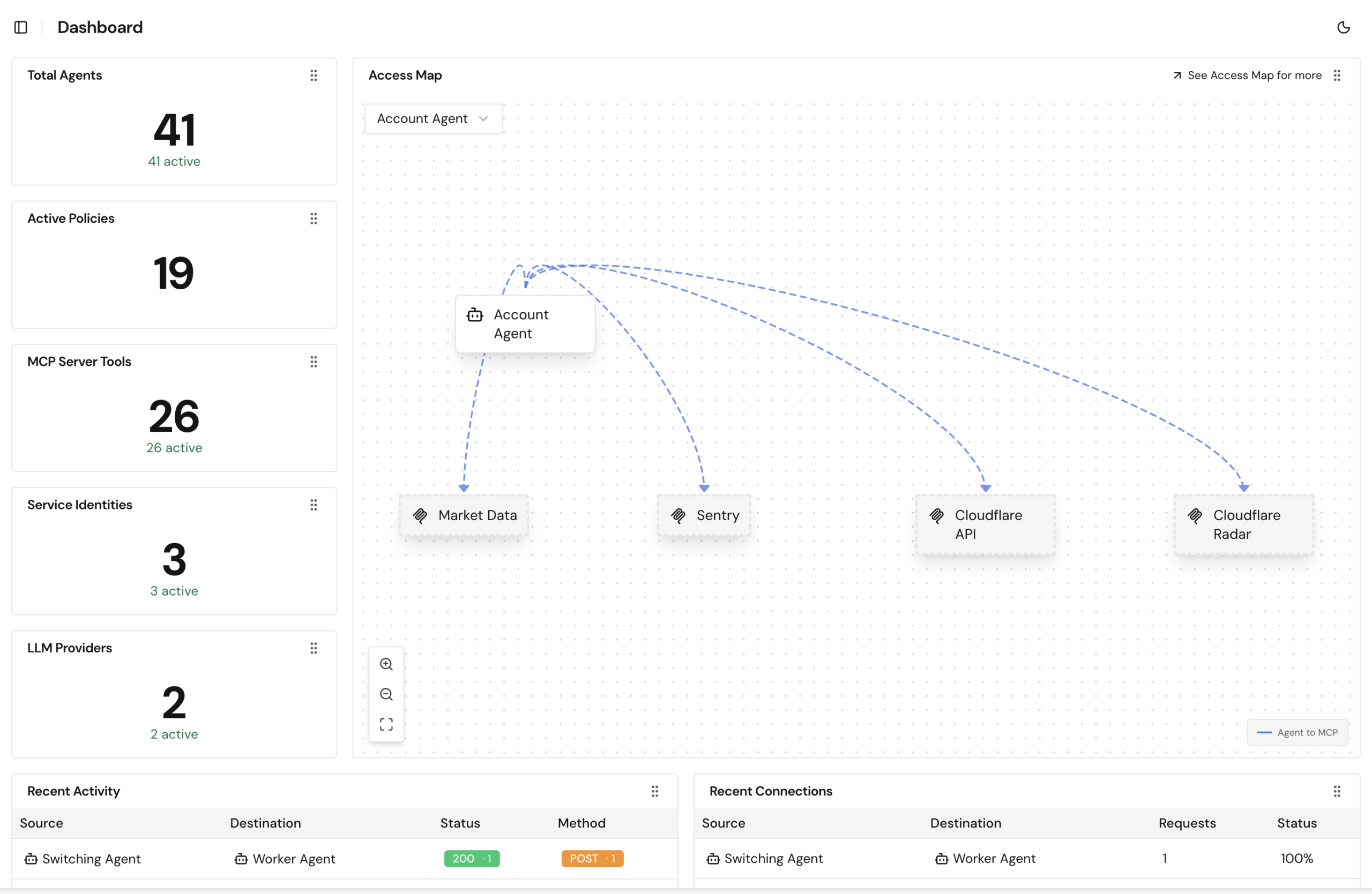
Source: Tigera
2. AppGate ZTNA

AppGate ZTNA secures AI agent workloads by enforcing zero trust access at the level of identities, workloads, and services instead of relying on network perimeters. It verifies human users and machine identities before allowing access and evaluates real-time context such as workload posture, compliance state, and risk signals.
General features:
- Identity-based access control: Authenticates users and AI agents through identity providers or workload identity systems
- Context-aware authorization: Evaluates factors such as device posture, workload health, compliance status, and risk signals before granting access
- Granular entitlement model: Restricts access to specific APIs, services, and data sources rather than broad network-level permissions
- Cloaked infrastructure exposure: Keeps services, APIs, and dashboards hidden until authentication and authorization succeed
- Direct-routed connectivity: Establishes low-latency connections between clients and services without routing traffic through centralized gateways or cloud chokepoints
Kubernetes-related features:
- Headless client deployment on nodes: Installs lightweight clients on Kubernetes nodes running AI agents to enforce secure access at the workload level
- Workload identity enforcement: Controls access to Kubernetes services and APIs based on workload identity rather than pod IPs or network location
- Cluster-wide policy integration: Applies dynamic access policies across Kubernetes environments
- Secure API and service access: Restricts AI agents to Kubernetes-hosted services and external endpoints they are authorized to use
- Dynamic access control for scaling workloads: Maintains consistent security policies as pods scale up or down
Source: AppGate
3. Microsoft Agent Governance Toolkit
The Microsoft Agent Governance Toolkit is an open-source runtime security framework that enforces governance over autonomous AI agents by embedding control mechanisms into their execution flow. It applies concepts from operating systems, service meshes, and site reliability engineering to manage how agents act, communicate, and access resources.
General features:
- Agent OS (policy engine): Stateless enforcement layer that intercepts agent actions and evaluates them against policies defined in YAML, OPA Rego, or Cedar
- Sub-millisecond enforcement: Executes policy decisions with latency under 0.1 ms (p99)
- Agent mesh identity system: Uses decentralized identifiers (DIDs) with Ed25519 cryptography to establish agent identities and enable secure communication
- Dynamic trust scoring: Assigns agents a behavioral trust score (0–1000) with tiered privilege levels based on observed activity
- Secure inter-agent communication: Implements the Inter-Agent Trust Protocol (IATP) to encrypt and validate communication between agents
Kubernetes-related features:
- Sidecar deployment model: Runs the Agent OS policy engine as a sidecar container alongside agents in Kubernetes
- AKS-native deployment support: Provides deployment patterns for Azure Kubernetes Service
- Workload-level enforcement: Intercepts and governs actions of agents running inside Kubernetes pods before execution
- Stateless and horizontally scalable design: Scales across Kubernetes clusters without maintaining stateful dependencies
- Dynamic policy enforcement at runtime: Evaluates agent actions within Kubernetes and enforces policies

Source: Microsoft Agent Governance
4. Teleport
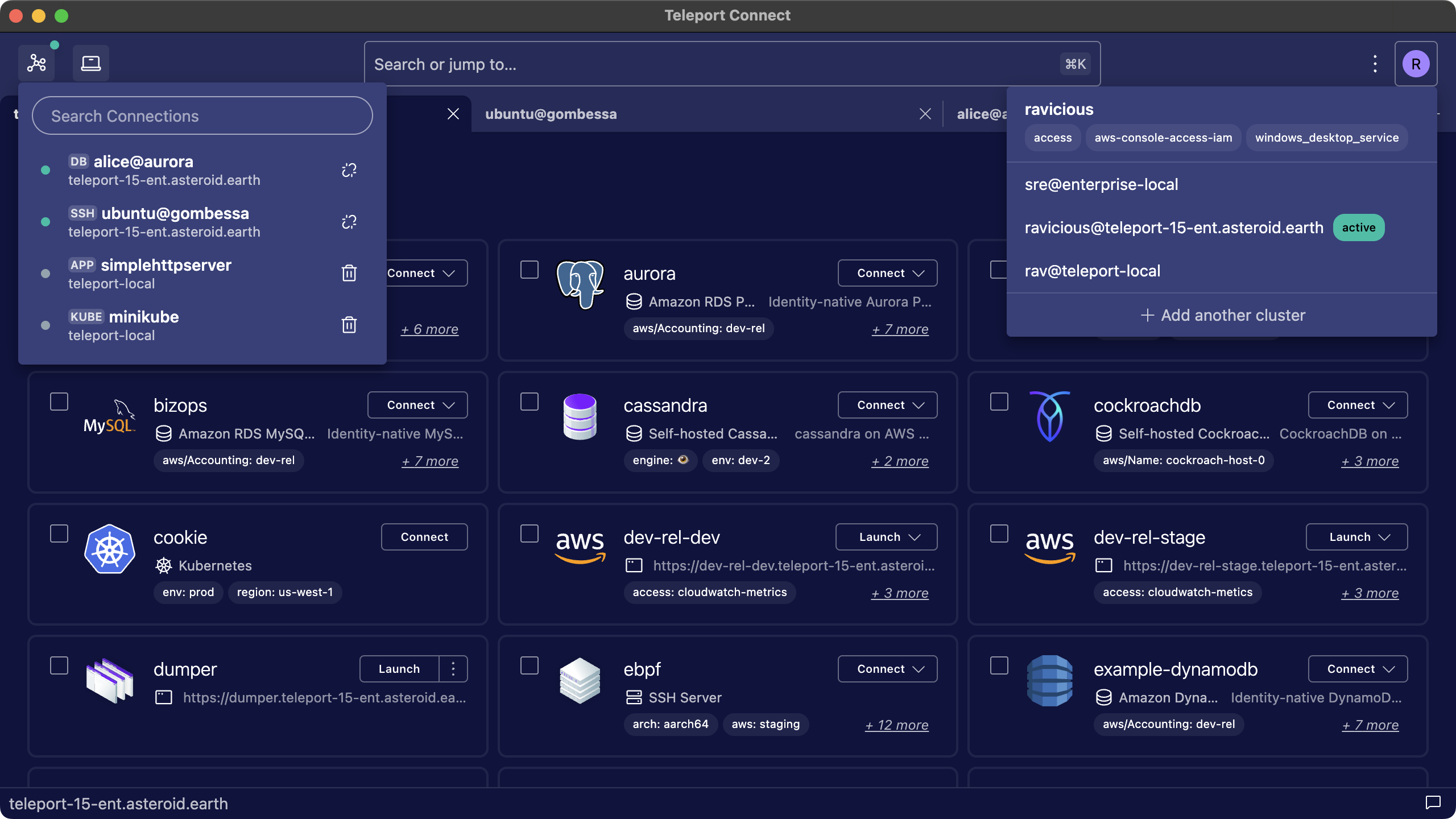
Teleport is an identity-focused security platform that controls access across AI infrastructure by assigning cryptographic identities to users, machines, and AI agents. Instead of relying on static credentials or network-based controls, it enforces zero trust access through short-lived identities, policy-driven authorization, and audit logging.
General features:
- Cryptographic identity for all actors: Assigns identities to users, machines, AI agents, and services, removing reliance on API keys or shared credentials
- Zero trust access model: Enforces identity-based access to infrastructure and services without trusting network location
- Elimination of static secrets: Replaces long-lived credentials with short-lived, identity-based access
- Unified access control layer: Applies consistent policies across humans, workloads, agents, and tools
- Just-in-time (JIT) privilege elevation: Grants temporary access for sensitive operations and revokes it automatically
Kubernetes-related features:
- Zero trust access to Kubernetes clusters: Controls access to Kubernetes APIs and workloads using identity-based authentication instead of kubeconfig files or static credentials
- Unified identity across cluster workloads: Extends the same identity model to pods, services, and agents running in Kubernetes
- Fine-grained access to cluster resources: Enforces least-privilege policies for actions against Kubernetes resources and services
- Audit logging for Kubernetes interactions: Records access and operations within Kubernetes clusters, including agent-driven actions
- Integration with AI orchestration tools: Works with systems like Ray, Airflow, and other pipelines deployed on Kubernetes
Source: Teleport
5. Agentic AI Governance Assurance and Trust Engine (AAGATE)
AAGATE (Agentic AI Governance Assurance & Trust Engine) is a governance platform that enforces continuous runtime control over autonomous AI agents by translating risk frameworks into executable security mechanisms. Built as a Kubernetes-native control plane, it operationalizes the NIST AI Risk Management Framework (RMF) by embedding governance into agent workflows, infrastructure, and communication layers.
General features:
- NIST AI RMF alignment: Implements the Govern, Map, Measure, and Manage functions as runtime controls
- Governing-Orchestrator Agent (GOA): Central component that processes telemetry, classifies risks, and enforces rapid responses
- Continuous compliance evaluation: Uses policy engines (OPA + Rego) and OWASP AIVSS scoring to assess agent behavior against requirements
- Shadow monitoring (Janus SMA): Re-evaluates agent actions before execution to detect unsafe or malicious behavior
- Tool-Gateway enforcement layer: Routes external interactions, including APIs, databases, and files, through an auditable control point
Kubernetes-related features:
- Kubernetes-native control plane: Deploys as an overlay architecture integrated with Kubernetes to govern agent workloads at runtime
- Centralized agent identity service (ANS): Manages identity registration and authentication for agents running in Kubernetes
- Policy enforcement within cluster workflows: Applies OPA-based policies directly to agent actions and service interactions in Kubernetes
- Runtime telemetry and observability: Streams behavioral and security data from Kubernetes workloads into analytics pipelines for risk evaluation
- Secure tool and API access: Controls how agents interact with external services from within Kubernetes through the Tool-Gateway control point
Related content: Read our guide to AI agent security providers
Conclusion
AI agent security platforms extend Kubernetes security by focusing on how autonomous workloads behave, interact, and access resources. They address gaps left by traditional tools by adding identity-aware controls, behavioral monitoring, and runtime policy enforcement. As AI agents become more integrated into production systems, these platforms help reduce risk by limiting unintended actions, securing data flows, and ensuring that agent behavior stays within defined boundaries.