






What Are Kubernetes Security Platforms?
Kubernetes security platforms are tools to enforce security in Kubernetes environments. Kubernetes, a container orchestration system, enables the deployment, scaling, and management of containerized applications. However, its complexity introduces potential security vulnerabilities that can be exploited if not properly managed.
Kubernetes security platforms address these challenges by providing various security measures, ranging from access control to threat detection. They integrate with Kubernetes to protect containers and ensure compliance with security best practices. They monitor and enforce security policies, ensuring that only approved containers operate within the environment, and can detect and respond to threats in real time, minimizing security risks.
Editor’s note: Updated the article to cover Kubernetes security market trends, updated information about Kubernetes security platforms to reflect features and capabilities in 2026.
In this article:
- Kubernetes Security Market and Trends
- Key Features of Kubernetes Security Platforms
- Notable Kubernetes Security Platforms
- How to Choose Kubernetes Security Platforms
Kubernetes Security Market and Trends
According to recent market research, the Kubernetes security market is valued at USD 1.72 billion, and growing at a compound annual growth rate of 25.8%, expected to reach USD 13.18 billion by 2033. This expansion reflects increasing reliance on containerized applications and the need to secure dynamic, cloud-native environments.
Key Growth Drivers
A major driver is the widespread adoption of Kubernetes for managing containerized workloads. Organizations use it to improve scalability and accelerate development, but its complexity introduces security risks. This drives demand for tools that provide visibility, threat detection, and automated response.
Regulatory pressure is another factor. Industries such as finance, healthcare, and government must comply with standards like GDPR, HIPAA, and PCI DSS. Kubernetes security platforms help enforce policies, manage vulnerabilities, and produce audit logs to support compliance.
Impact of Cloud and Architecture Trends
The rise of hybrid and multi-cloud environments is expanding the attack surface. Organizations are running workloads across on-premises and multiple cloud providers, making consistent security harder to maintain.
Kubernetes security tools are evolving to address this by offering centralized monitoring and unified policy management across environments. This is especially important for large enterprises with complex infrastructure.
The shift toward cloud-native architectures and DevSecOps practices is also sustaining demand for integrated security solutions.
Role Of Generative AI In Kubernetes Security
Generative AI is emerging as a transformative force in Kubernetes security. AI-powered tools can analyze vast volumes of logs, configurations, and runtime data to detect anomalies, predict threats, and recommend remediation steps in real time.
Large language models (LLMs) are increasingly being integrated into Kubernetes environments to assist with security operations, such as identifying misconfigurations, automating policy generation, and improving incident response workflows.
At the same time, the adoption of generative AI workloads on Kubernetes is creating new security challenges. AI applications are becoming mission-critical, but many organizations still lack proper access controls and protections, increasing the risk of data exposure and breaches.
As a result, vendors are embedding AI-driven capabilities, such as automated threat detection, AI copilots for security teams, and predictive risk analysis, into Kubernetes security platforms. This dual role of generative AI as both a security enabler and a new attack surface is expected to significantly shape the market’s evolution over the coming years.
Key Features of Kubernetes Security Platforms
Runtime Threat Detection
Runtime threat detection provides real-time monitoring of running containers to identify suspicious activities. This involves analyzing container behavior, system calls, and other runtime metrics to detect anomalies that could indicate a security breach. By leveraging machine learning and behavior analysis, these platforms can identify deviations from normal patterns.
Effective runtime threat detection enables swift incident response, reducing the potential damage of security events. Alerting mechanisms provide administrators with timely notifications of detected anomalies, enabling prompt investigation and remediation.
Network Policy Enforcement
Network policy enforcement is vital in Kubernetes security, managing the network traffic between pods and services. This feature defines and applies rules that determine allowable communication paths, restricting data flow to only trusted sources and destinations. By implementing such policies, security platforms help prevent unauthorized access and lateral movement within Kubernetes clusters.
Ensuring strict network policy enforcement also aids in compliance with regulatory and organizational security policies. By leveraging Kubernetes-native network policy objects, security platforms can efficiently create and manage these rules at scale. This network segmentation helps minimize attack surfaces and limits exposure.
In addition to network policy objects, modern clusters often use the Kubernetes Gateway API to manage ingress and east-west traffic routing, which security platforms can integrate with to apply consistent policy enforcement at the gateway layer.
Access Control and Authentication
Effective access control ensures that only authorized personnel have the necessary permissions to execute certain actions. Kubernetes security platforms implement role-based access control (RBAC), allowing administrators to define and enforce fine-grained permissions, ensuring users have precisely the access level necessary for their roles.
Authentication complements access control by verifying the identity of users and services attempting to interact with Kubernetes resources. Integration with identity providers and leveraging mechanisms like two-factor authentication can improve security. This dual approach ensures consistent authorization enforcement and identifies all actors in the environment.
Image Scanning
Image scanning involves identifying vulnerabilities and misconfigurations in container images before deployment. Security platforms integrate with image registries to automatically scan images, flagging insecure or outdated components and suggesting remediation. This aids in reducing the chances of propagating vulnerabilities into production environments.
Regular image scanning aligns with best practices for container security, ensuring that only compliant images are used in Kubernetes clusters. By maintaining secure container images, organizations mitigate the risk of known vulnerabilities being exploited in their systems.
Tracking recent Kubernetes vulnerability trends and common exploit techniques can help teams prioritize which security platform capabilities matter most for their environment.
Compliance and Auditing
Compliance and auditing help ensure adherence to industry standards and regulatory requirements. Kubernetes security platforms offer tools to automate compliance checks and generate audit reports that provide visibility into security practices. Such features allow organizations to identify gaps and remediate compliance issues, minimizing the risk of regulatory penalties.
By maintaining audit trails and compliance checks, organizations can prove adherence to various security frameworks and regulations. Auditing helps track all actions and changes within the environment, enabling accountability and traceability of incidents. In addition, automated compliance tools enable continuous monitoring of security postures.
Related content: Read our guide to Kubernetes security checklist
Notable Kubernetes Security Platforms
1. Calico (by Tigera)
Calico is a Kubernetes network security and observability platform designed for securing workloads across containers, virtual machines, and bare metal. It provides dynamic network security policies to prevent unauthorized access and lateral movement. Calico enables full workload portability and the ability to define segmentation policies for multi-cloud and hybrid connections. It is built for cloud scale and provides you with the ability to roll out security policy changes in milliseconds, while legacy segmentation tools take hours.
License: Apache License 2.0
Repository: https://github.com/tigera/calico
GitHub stars: 6.5K
Contributors: 350+
Key features include:
- Dynamic segmentation: Uses workload metadata to enforce segmentation policies automatically, ensuring consistent security as workloads scale.
- Policy enforcement: Supports microsegmentation with fine-grained policy controls at the workload level. Policies can be staged, previewed, and modified before deployment.
- Visibility: Provides detailed insights into network activity and policy impact, enabling security teams to optimize segmentation strategies.
- Scalability: Designed for high-performance enforcement across large-scale cloud and hybrid environments without centralized bottlenecks.
- Automated policy recommendations: Analyzes workload behavior and suggests security policies, reducing manual effort and simplifying microsegmentation adoption.
- Supports container, VM, and bare metal: Ensures consistent security policy enforcement across diverse environments, including containers, virtual machines, and physical servers.

Source: Tigera
2. SentinelOne Singularity Cloud Security
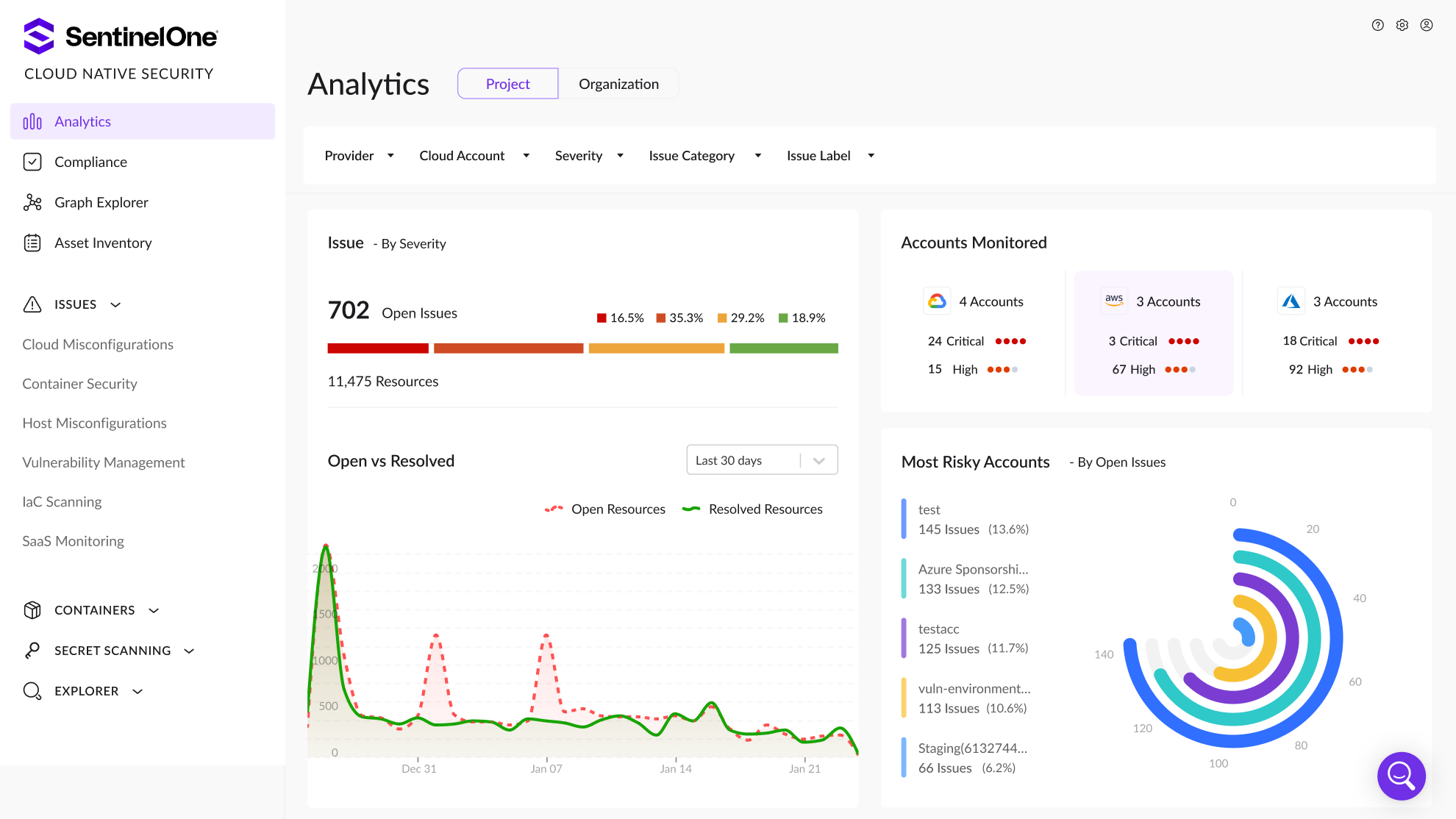
SentinelOne Singularity Cloud Security is a cloud-native application protection platform (CNAPP) that combines multiple security functions into a unified system. It provides visibility across cloud assets, workloads, and identities, while supporting Kubernetes and other environments. The platform focuses on real-time threat detection, risk prioritization, and automated response.
License: Commercial
Key features include:
- Unified CNAPP platform: Provides centralized visibility and control across cloud resources, workloads, and identities from build time to runtime.
- Real-time detection and response: Uses AI-driven monitoring to detect and respond to threats across Kubernetes and other environments.
- Verified exploit path analysis: Prioritizes risks by identifying realistic attack paths that could be exploited.
- Agentless and agent-based coverage: Supports flexible deployment and protection for containers, Kubernetes, VMs, and serverless workloads.
- Kubernetes security posture management: Detects misconfigurations and aligns clusters with compliance standards.
- DevSecOps integration: Scans code repositories, container images, and infrastructure-as-code templates within CI/CD pipelines.
Source: SentinelOne
3. Falco

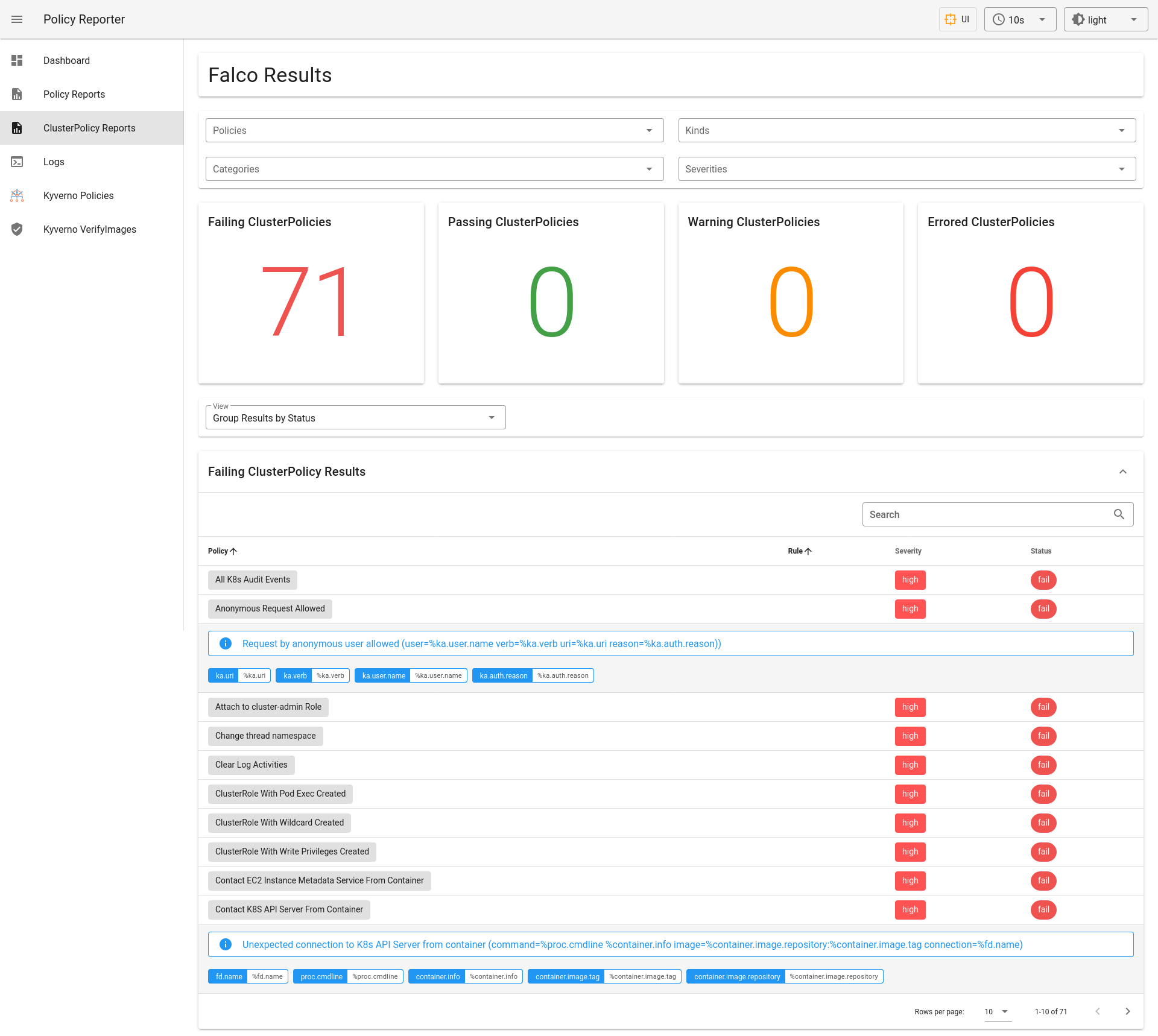
Falco is an open-source runtime security tool that monitors containers, hosts, and Kubernetes environments for suspicious activity. It works by collecting system-level and cloud-native events, then evaluating them against predefined or custom rules. Falco focuses on detecting abnormal behavior as it happens, allowing teams to respond quickly to threats such as privilege escalation or unauthorized access.
License: Apache-2.0
Repo: https://github.com/falcosecurity/falco
GitHub stars: 7K+
Contributors: 100+
Key features include:
- Runtime threat detection: Monitors live activity across containers and Kubernetes to identify suspicious behavior.
- Rule-based detection engine: Uses predefined and custom rules to classify events as normal or malicious.
- Multiple data sources: Analyzes Linux system calls, Kubernetes audit logs, and cloud provider events.
- Extensibility via plugins: Supports additional event sources through a plugin framework.
- eBPF and kernel module support: Captures system-level activity efficiently using modern kernel instrumentation methods.
- Alert forwarding and response integration: Sends events to external systems for automated response and remediation.
Source: Falco
4. Sysdig Secure

Sysdig Secure is a cloud-native security platform that protects containers and Kubernetes environments with real-time visibility and risk-based prioritization. It correlates runtime activity, vulnerabilities, and configuration data to help teams focus on the most critical threats. The platform emphasizes fast detection and response, supported by contextual insights into workloads and infrastructure.
License: Apache-2.0
Repo: https://github.com/draios/sysdig
GitHub stars: 8K+
Contributors: 100+
Key features include:
- Real-time visibility: Provides insight into container and Kubernetes activity as it occurs.
- Risk prioritization: Correlates vulnerabilities, exploitability, and exposure to highlight the most critical issues.
- Runtime threat detection: Identifies attacks quickly using detection rules and behavioral monitoring.
- Context-rich investigation: Combines system calls, metadata, and infrastructure context for faster incident analysis.
- Kubernetes security posture management: Links misconfigurations to infrastructure-as-code for simplified remediation.
- Integrated detection and response: Enables rapid investigation and response workflows across cloud-native environments.
5. Anchore
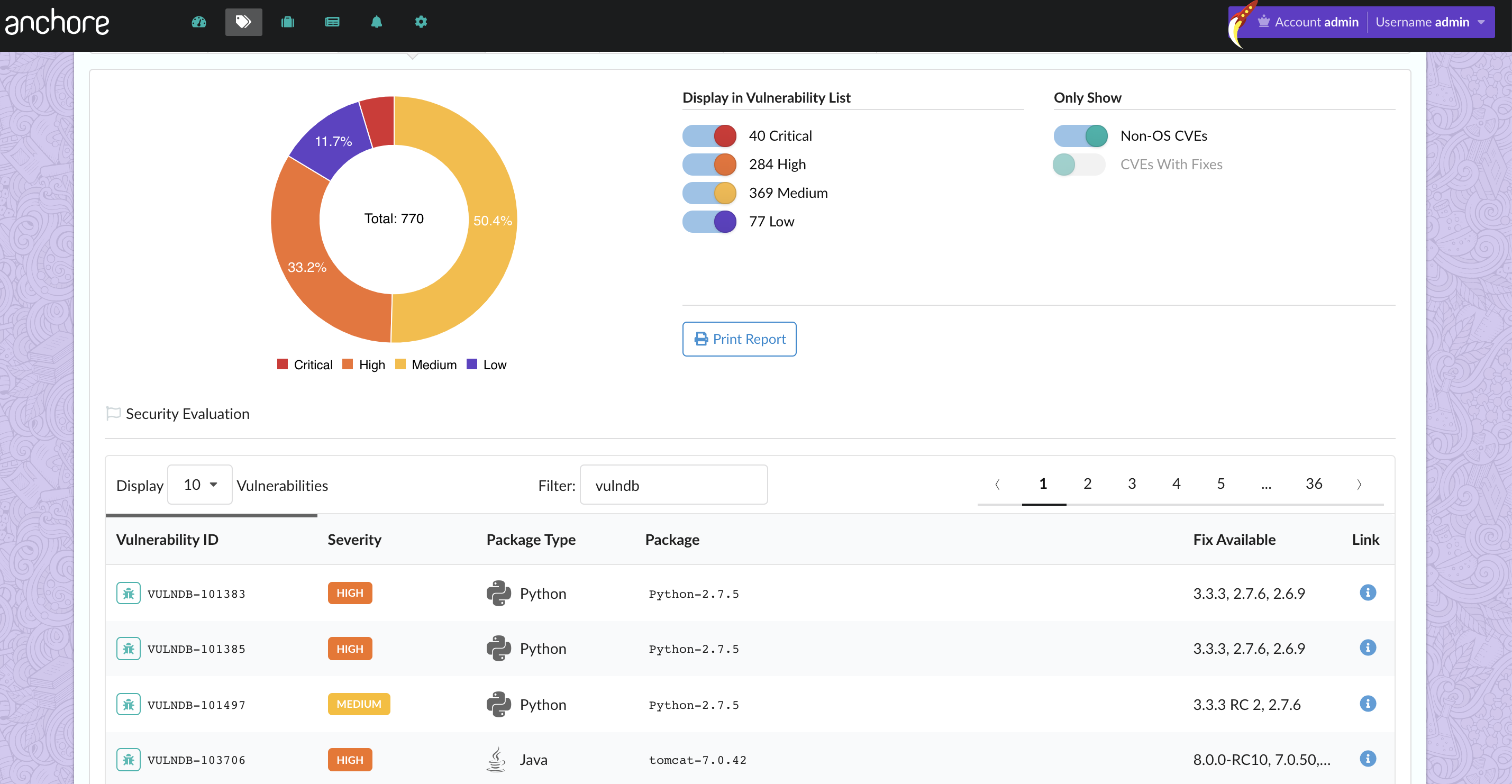
Anchore is a container security platform focused on image scanning, policy enforcement, and software supply chain security. It integrates with Kubernetes to ensure only compliant images are deployed and continuously monitors running containers for vulnerabilities. Anchore emphasizes automation and visibility across the lifecycle of container images.
License: Commercial
Key features include:
- Image policy enforcement: Uses a Kubernetes admission controller to allow or block deployments based on security policies.
- Continuous image scanning: Monitors container images for vulnerabilities before and after deployment.
- Runtime vulnerability detection: Identifies newly discovered vulnerabilities affecting running containers.
- Software bill of materials (SBOM) management: Tracks dependencies to improve visibility into software components.
- CI/CD integration: Embeds security checks into development pipelines to detect issues early.
- Compliance automation: Applies predefined and custom policies to support regulatory requirements.
Source: Anchore
6. Kubescape
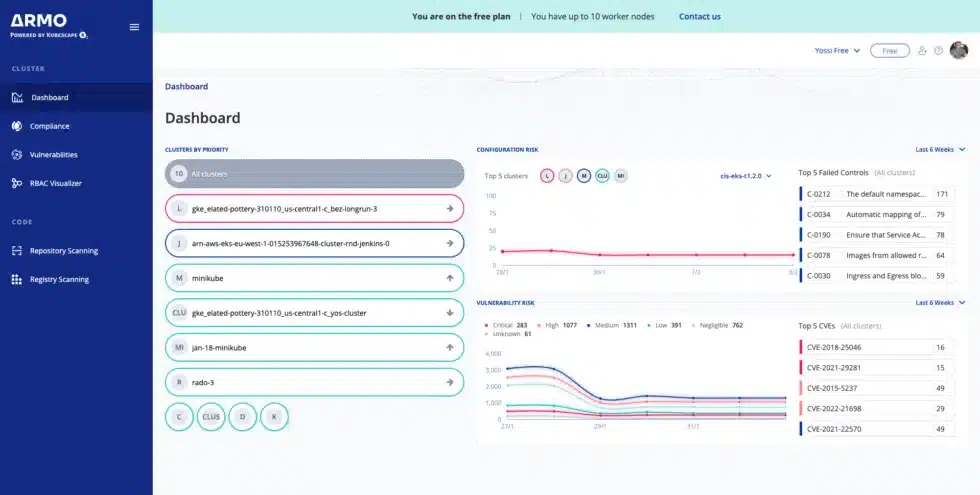
Kubescape is an open-source Kubernetes security platform for developers and DevSecOps teams. It provides tools for scanning configurations, enforcing compliance, and identifying risks across clusters and pipelines. The platform integrates with development environments and CI/CD systems to embed security throughout the lifecycle.
License: Apache-2.0
Repo: https://github.com/kubescape/kubescape
GitHub stars: 10K+
Contributors: 100+
Key features include:
- Kubernetes compliance scanning: Validates configurations against frameworks such as CIS, NSA-CISA, and MITRE ATT&CK.
- Misconfiguration detection: Identifies security issues and configuration drift in Kubernetes resources.
- CI/CD integration: Embeds security checks into pipelines to catch issues before deployment.
- Kubernetes hardening: Provides guidance and controls to improve cluster security posture.
- Multi-cloud support: Works across different cloud providers and environments.
- CLI and developer tooling: Offers a command-line interface and integrations with IDEs for ease of use.
Source: Kubescape
7. Aqua Platform

Aqua Platform is a CNAPP solution that secures Kubernetes environments across the application lifecycle. It combines security posture management, runtime protection, and policy enforcement using Kubernetes-native controls. The platform focuses on reducing risk through automated checks, visibility, and enforcement of least privilege and compliance policies.
License: Apache-2.0
Repo: https://github.com/aquasecurity/trivy
GitHub stars: 25K+
Contributors: 400+
Key features include:
- Kubernetes security posture management: Continuously evaluates configurations and risks across clusters.
- Runtime protection: Detects and mitigates threats during application execution.
- Workload admission control: Enforces policies to prevent insecure workloads from being deployed.
- Risk visualization: Maps cluster components and highlights security risks in real time.
- Compliance checks: Automates validation against benchmarks such as the CIS Kubernetes Benchmark.
- Identity-based segmentation: Applies network controls based on workload identity and Kubernetes context.
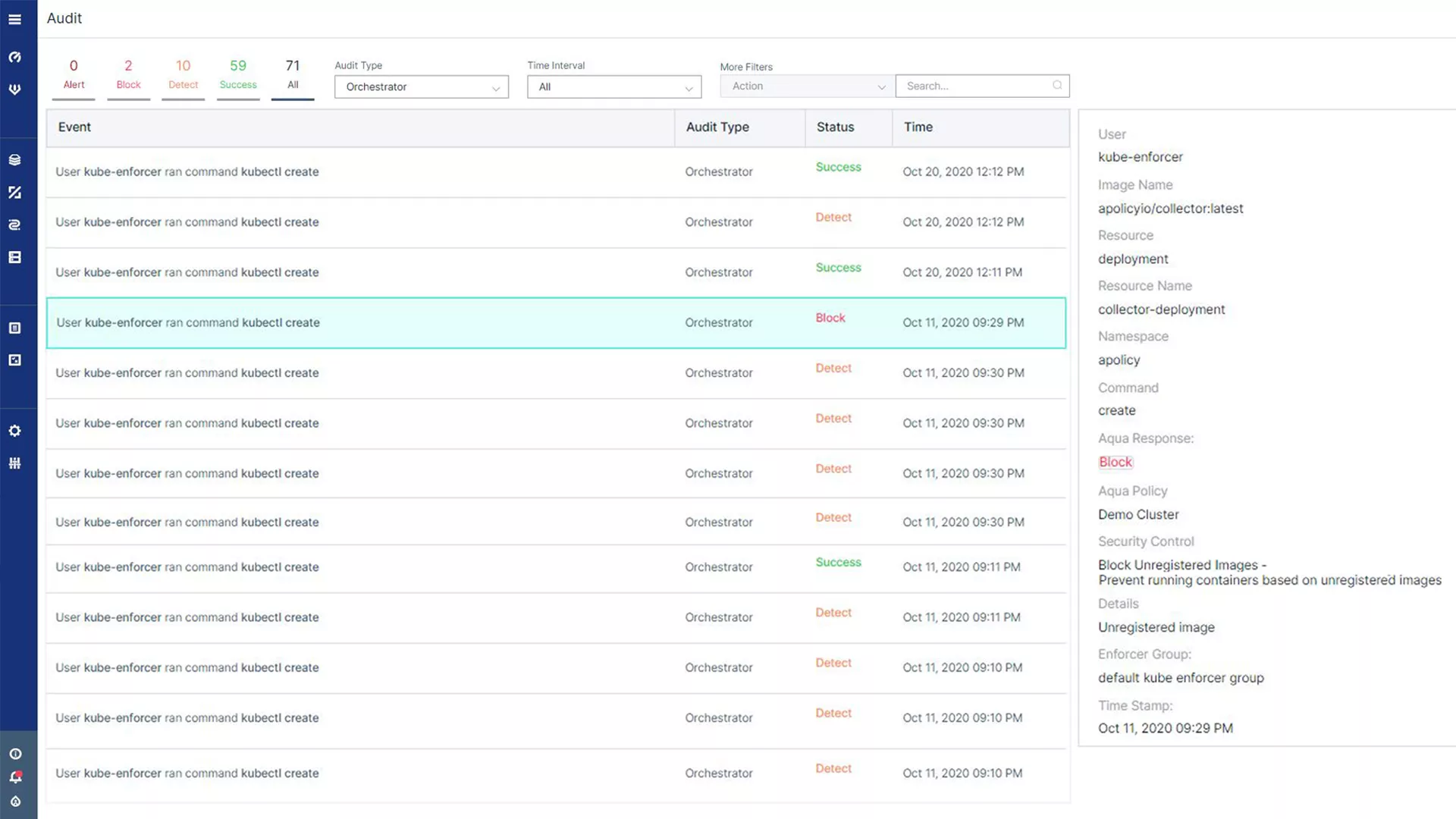
Source: Aqua Security
8. Palo Alto Prisma Cloud
Prisma Cloud is a cloud-native security platform that provides protection for Kubernetes applications from development to runtime. It connects insights from code, configuration, and runtime activity to detect risks and enforce security policies. The platform emphasizes integrating security into development workflows while maintaining runtime protection.
License: Commercial
Key features include:
- Code-to-cloud intelligence: Links development and runtime data to identify and prevent risks across the lifecycle.
- Risk and misconfiguration prevention: Detects issues early and prevents insecure configurations from reaching production.
- Application context analysis: Uses contextual information to prioritize risks and support root cause analysis.
- Runtime protection: Monitors applications for anomalies, malware, and zero-day threats.
- Integrated compliance and security: Applies consistent policies across Kubernetes environments to improve security posture.
- DevSecOps enablement: Supports collaboration between development and security teams through integrated tooling.
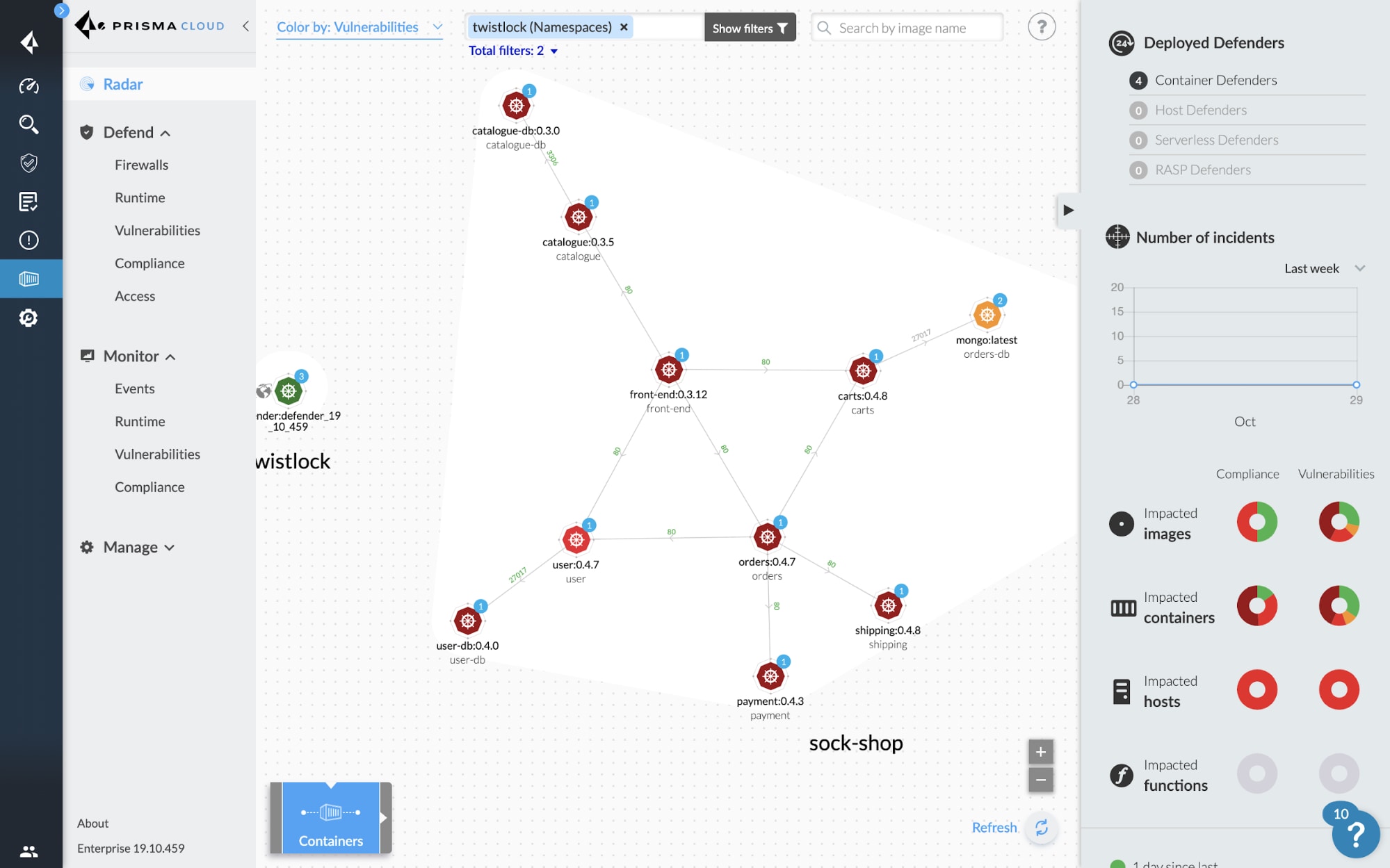
Source: Palo Alto Networks
How to Choose Kubernetes Security Platforms
Selecting a Kubernetes security platform involves evaluating operational needs, compliance requirements, and the scale of the Kubernetes environment. Below are key considerations to guide your decision:
- Coverage across the lifecycle: Look for platforms that provide security from development through runtime. This includes image scanning in CI/CD pipelines, policy enforcement at deployment, and threat detection in live environments.
- Integration capabilities: Choose tools that integrate smoothly with the existing Kubernetes distribution, cloud provider, CI/CD pipelines, and identity providers. This reduces overhead and promotes consistent security practices.
- Compliance and governance support: Ensure the platform offers automated compliance checks against standards like CIS, NIST, PCI, and SOC2, along with detailed audit logs and reporting capabilities.
- Runtime threat detection and response: Evaluate the platform’s ability to detect and respond to threats in real time using behavior analysis, anomaly detection, or eBPF-based system call monitoring.
- Policy management and enforcement: Strong support for Kubernetes-native policies (like OPA or Kyverno) enables consistent enforcement of security and operational rules across all clusters.
- Visibility and observability: Look for features that provide insights into workloads, network flows, RBAC policies, and attack surfaces. Clear dashboards and contextual alerts help reduce response times.
- Scalability and performance: The platform should handle large-scale, dynamic Kubernetes environments without degrading cluster performance or requiring intrusive agent installations.
- Open source vs. commercial options: Consider whether an open-source solution meets the organization’s needs or if a commercial offering is warranted for additional enterprise features, support, and SLAs.
- Community and vendor support: A strong user community or responsive vendor can be crucial for resolving issues, staying updated on vulnerabilities, and adapting to evolving best practices.